Tonight at Ilkley Camera Club we had a fascinating practical studio session with Tabitha Boydell and model Erica Mulkern.
Tabitha Boydell runs a business offering location shoots in some of the most lavish and visually striking settings around the country. Her events provide access not only to beautiful venues, but also to professional lighting setups, experienced models, and carefully curated costumes. (You can explore her work through her website.)
This kind of session isn’t something I’ve done before. However, looking through Tabitha’s portfolio, many of the resulting images are truly spectacular.
More Than Just “Taking the Shot”
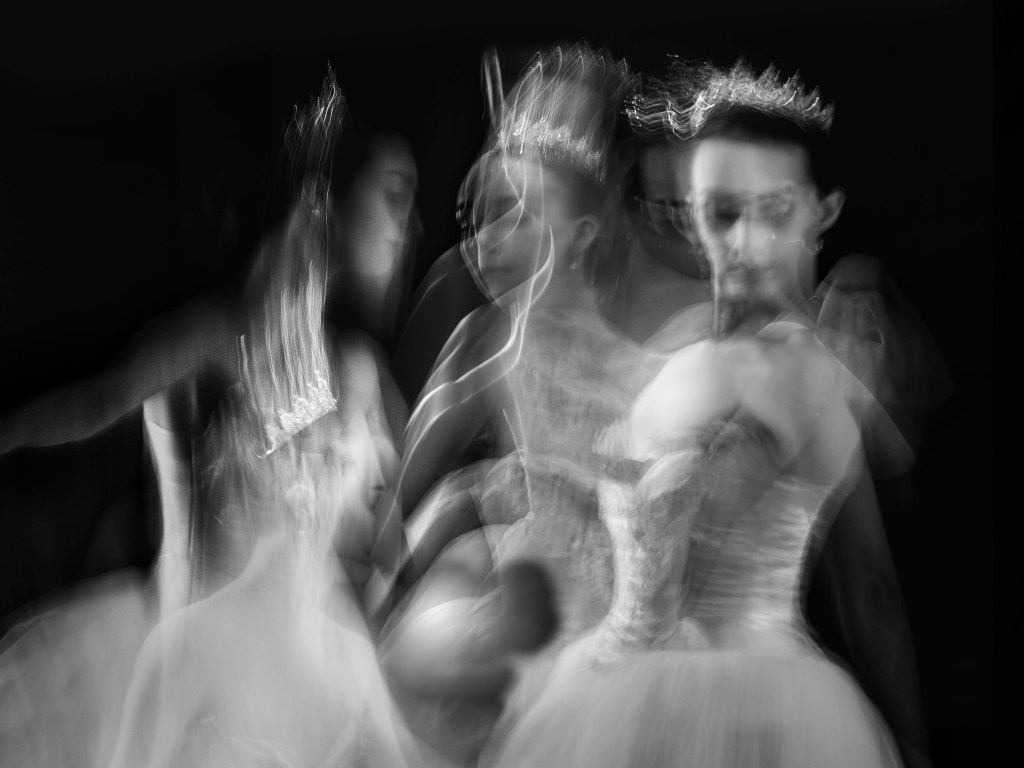
During the evening, Tabitha worked closely with Erica Mulkern to pose and create a studio lighting arrangement for us to use. Sessions like these are necessarily limited — especially when several photographers are sharing time and wanting to practise — but they offer an excellent opportunity to refine technical skills, particularly with strobe lighting, and to work with an experienced model.
Yet beyond the technical learning, I was eager to explore something deeper.
In a setting where the location, the lighting, and the model are already carefully prepared, the temptation is simply to “take the shot.” But a photograph is not merely a picture of something attractive. It is the outcome of a relationship — a “dialogue” between the photographer and the subject.
Entering the Dialogue
It is relatively easy to photograph something already beautiful: an elegant dancer, a dramatic landscape, a poised model. But what has the photographer contributed? What has been added beyond competent exposure and composition?
The real challenge in creative photography is not simply to record beauty, but to respond to it — to enter into dialogue with it — and to allow that exchange to shape the final image.
When photographer and subject truly interact, something new emerges. The subject offers presence, expression, character. The photographer brings interpretation, intention, and vision. The resulting photograph is not merely the sum of these parts, but something unique — a third thing born of that interaction.
Bringing Ourselves Into the Frame
In studio sessions like this, the question becomes: is it enough to capture what is placed before the camera, or should we bring something of ourselves into the frame?
Looking at Tabitha’s portfolio, it is clear that many photographers who attend her sessions do more than document the scene. They add a layer of imagination — a personal response that transforms a well-arranged opportunity into something distinctly their own.
Perhaps the true challenge, whenever we encounter a beautiful subject, is not simply to photograph it well, but to enter into a kind of conversation: to listen, to respond, and to shape something individual out of that relationship.
In that sense, photography is less about taking and more about engaging — and the image becomes the visible trace of that conversation.

 MARK WADDINGTON
Leave a comment