This post is part of my ongoing exploration into what makes a great photograph. Lately, I’ve been asked to judge a few photographic competitions, which has really made me think about how we decide what makes one image stand out over another. To do that fairly, you need some kind of framework—a way to explain why certain photos deserve recognition. The tricky part is keeping those criteria simple enough to communicate, but broad enough to work across all the different styles and approaches you see in a competition. You have to think about things like technical ability, composition, and creativity—each of which is a deep subject on its own. And, of course, there’s always that tension between judging something “objectively” and knowing that, in the end, photography is a deeply subjective art.
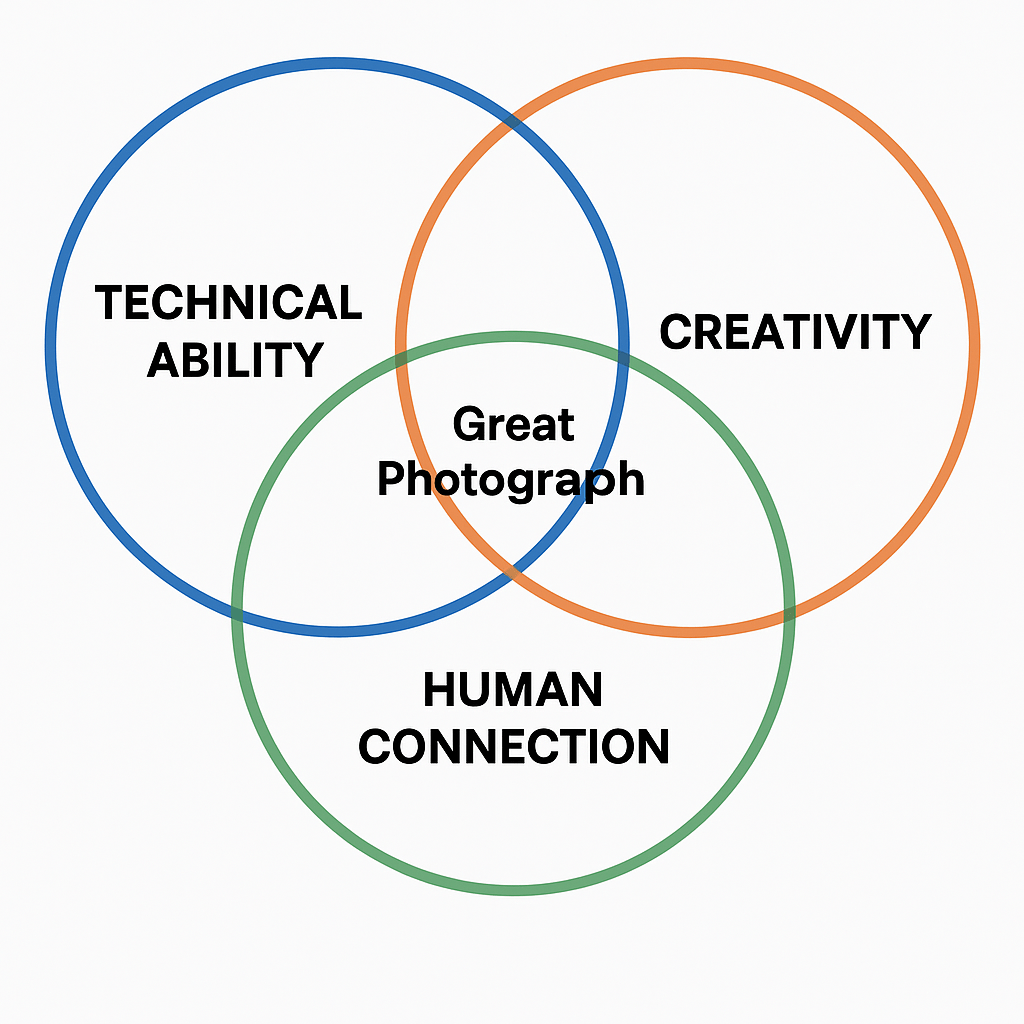
When we think about what makes a great photograph, I believe we can draw three overlapping circles — each representing a vital dimension of photographic excellence. Together, they form a kind of Venn diagram for understanding not only how we take photographs, but how we create meaningful visual art.
1. Technical Ability
The first circle is technical ability — the craft of photography. This includes mastery over the camera: control of lighting, exposure, focus, and all the technical elements that produce a good image. Composition also belongs here — the ability to use framing, scale, depth, and perspective to lead the viewer’s eye and communicate a sense of balance or drama.
Technical ability ensures the photograph “works.” It’s the part of photography most often emphasized in competitions and camera clubs, where the precision of exposure or sharpness of focus is often rewarded. Many photographers take their inspiration from others and adopt well-known techniques, producing technically excellent but familiar images.
There’s nothing wrong with that — but it’s only one circle.
2. Creativity and Originality
The second circle is creativity. Creativity goes beyond technique; it’s the spark of originality that brings something new into the world. It’s about experimentation, expression, and authenticity — the photographer’s ability to translate their own way of seeing into an image that feels fresh.
Originality isn’t about novelty for its own sake, but about personal insight. A creative photograph makes us pause and think, “I haven’t seen it like that before.” It’s that sense of discovery that keeps photography alive and evolving.
This circle can exist independently of technical mastery. Experimental and playful photography often thrives precisely because it breaks the rules. But when creativity and technical ability meet, something special happens — images that are both well-crafted and deeply original.
3. Human Connection
The third circle is the most vital and perhaps the most neglected: human connection. This is the power of a photograph to move us — to evoke emotion, empathy, or even challenge our beliefs.
A great photograph doesn’t just show something; it makes us feel something. That emotional or intellectual spark connects photographer and viewer in a shared human moment. It might be joy, sadness, curiosity, or wonder — but it’s that connection that gives photography its lasting power.
This is the circle where photography becomes more than craft — it becomes art.
The Overlap: Where the Magic Happens
Each of these circles can exist on its own. Technical photography might serve science or documentation — precise, accurate, and emotionally neutral. Creative photography might be exploratory or conceptual without technical polish. Photographs that focus purely on emotional connection might be spontaneous or imperfect, yet deeply moving.
But in the overlap — where all three circles meet — we find the truly great photographs.
These are images that are well-made, original, and emotionally resonant. They don’t just record the world; they reveal it anew.
Artificial Intelligence and the Human Touch
In the age of artificial intelligence, this third circle — human connection — becomes even more crucial. AI can now simulate technical ability and even mimic creative styles, but it struggles to convey genuine human emotion or imperfection.
This should prompt us to ask: What makes a photograph truly human?
Perhaps it’s the trace of the artist’s hand — the momentary decision, the emotional vulnerability, the imperfection that reveals authenticity.
Rather than competing with AI for flawless production, photographers might lean into what makes us distinct: our ability to feel, to respond, to connect.
In the future, photography that bears the mark of a real person — expressive, imperfect, emotional — may stand out as the most valuable of all.
© Mark Waddington 2025
 Mark Waddington
Leave a comment