Tag: photographer

  • A Photograph Is More Than What’s Inside the Frame

    A Photograph Is More Than What’s Inside the Frame

    I’m beginning to think that the real pleasure of photography does not come from making photographs at all.

    The more time I spend studying photography, the more convinced I become that context is perhaps one of the most important elements in our enjoyment of a photograph. I say this as someone who visits art galleries often and spends time reading the little captions beside the work. I want to know everything I can about the artist and the circumstances surrounding the work — whether it is painting or photography. This enhanced understanding makes the work come alive and feel more connected to my own life and experiences.

    I recently heard art historian Bendor Grosvenor talking about art connoisseurship, and it inspired me to think about how we learn not simply to see a picture, but to read it and forensically examine its qualities in different ways. Enjoyment comes from learning how to truly look at creative work — not simply at what is visible inside the frame, but at the deeper story of how and why an image came into being.

    A photograph can certainly be admired for its visual beauty or emotional impact alone. We can appreciate light, composition, colour, texture, timing, or technical skill. But photographs become far more exciting when we begin asking questions beyond the image itself.

    • Who made this photograph?
    • Why was it taken?
    • What was happening at that moment?
    • What relationship did the photographer have to the subject?
    • Where has this image appeared, and for what purpose?

    These questions transform a photograph from a static object into something alive.

    What Do We Mean by “Context”?

    When we talk about the context of a photograph, we are really talking about several overlapping layers.

    The first is the context of the moment itself: the time, the place, the historical circumstances, and the events unfolding around the photograph. A wartime image, for example, carries a very different emotional weight once we understand the dangers, politics, and human realities surrounding it.

    Then there is the photographer’s relationship to the scene. I spend a great deal of time walking on my local moors. It is a place where I feel peaceful and grounded. There can be wind and rain, and it is still beautiful. Moorland walking is something I have done since I was a small child, so my relationship with the moors is deeply rooted in me.

    The camera, it has been said, looks two ways — both at the scene and back at the photographer. So let’s consider that within the photograph itself. Was the photographer an observer, a participant, a friend, a stranger, or perhaps even someone at risk? Understanding this relationship can radically alter the way we interpret an image.

    But context does not stop with the photographer.

    The viewer also brings context.

    Each of us arrives carrying our own experiences, beliefs, memories, and assumptions. Two people can look at the same photograph and see entirely different things because they bring different emotional histories to the act of seeing. Sometimes a photograph resonates because it connects to a shared human experience. Sometimes our worldview changes what we notice, what we value, or what we overlook.

    As someone who is frequently asked to judge photographs in competitions, I am constantly having to navigate my own emotional responses to images, responses that may or may not be shared by other people.

    And then there is the context of presentation.

    A photograph seen in a gallery feels different from the same photograph seen in a newspaper, a family album, an advertising campaign, or on social media. The setting changes how we “read” the image. In a gallery, we expect contemplation and interpretation. On social media, we may give an image only a fraction of a second before scrolling on.

    All of these contexts shape meaning.

    Learning to See Better

    I increasingly enjoy looking at other people’s photographs more than making my own. In fact, I suspect that making photographs is partly valuable because it teaches us how to appreciate the work of others more deeply.

    By studying photographs carefully over time, we begin to calibrate our eyes. We become more sensitive to quality, nuance, intention, and originality. We start noticing things that would once have escaped our attention.

    This may be part of what Bendor Grosvenor calls connoisseurship.

    Being a connoisseur is not simply about having opinions. It is about developing the ability to see more fully. It means understanding not only what a photograph looks like, but who made it, how it was made, why it matters, and what makes it distinctive.

    Connoisseurship is really an act of attentive seeing.

    To become experienced viewers of photography, we have to train ourselves in the art of unravelling an image through observation, curiosity, and knowledge.

    And this is where context becomes so important.

    The enjoyment of a photograph comes not only from what is contained within the frame, but from our understanding of how the image came to exist at all. Knowing something about the photographer’s motivations, struggles, risks, or intentions can dramatically deepen our emotional connection to the work.

    Context in Exhibitions

    When I visit a photographic or art exhibition, I instinctively feel that this context matters.

    We expect captions, essays, catalogues, interviews, or background information to accompany the images. These materials help us enter the world of the work. They enrich our understanding and encourage us to look more carefully.

    Often, the greatest pleasure comes from doing our own research — discovering the stories behind the photographs, reading about the photographers, and immersing ourselves in the wider history surrounding the images.

    The photograph becomes part of a much larger human story.

    Social Media and Context

    Today, billions of images are uploaded online every year. Increasingly, social media has become the primary context in which photographs are viewed.

    But social media strips away much of the richness that gives photographs meaning.

    Images flash past detached from history, detached from authorship, detached from place and intention. We rarely know how an image was made, whether it has been manipulated, or even whether it depicts something real at all. Some images are now entirely AI-generated — pictures created without lived experience or genuine human connection behind them.

    The result is that photographs can become strangely weightless.

    We consume them rapidly, but rarely dwell on them deeply.

    I Struggle With Photographic Competitions

    If you’ve read some of my earlier posts, you’ll know that I have a slightly conflicted relationship with photographic competitions.

    As a competition judge, I’m asked to explain why certain photographs “work” and to make highly subjective decisions about winners and losers. But the more I judge competitions, the more I feel that the process is inherently unfair.

    Competition photographs are often stripped entirely of context.

    They are presented as isolated images with little or no sense of where they came from, who made them, or why they matter. They become, in a sense, orphaned photographs.

    And because context is absent, judging naturally gravitates towards the technical aspects of photography: sharpness, composition, exposure, impact, printing quality, and visual design.

    Those things matter, of course. Technical excellence matters enormously.

    But technical excellence alone is not the same as relevance, emotional depth, or human significance.

    In open competitions especially, judges compare photographs across wildly different genres and intentions with almost no understanding of the circumstances in which the images were made. The result is that photographs are often evaluated primarily as visual objects rather than lived experiences or meaningful acts of communication.

    Competitions create a very particular context with very particular rules.

    Within that setting, photography can become a largely technical exercise — impressive, perhaps, but detached from the deeper human connections that make photography truly powerful.

    Becoming Better Viewers

    I think the question of a photograph’s relevance is deeply important.

    Photography is not simply about producing attractive images. It is about seeing, understanding, remembering, communicating, and connecting.

    The more I learn about photography — its history, its makers, its stories, and its contexts — the richer my experience becomes. Hopefully, I stop merely looking at photographs and begin truly encountering them.

    And perhaps that is what it means to become an experienced viewer of photography.

    Not just someone who sees pictures. But someone who sees through them to something deeper and beyond.

  • The Three Circles of a Great Photograph 

    The Three Circles of a Great Photograph 

    This post is part of my ongoing exploration into what makes a great photograph. Lately, I’ve been asked to judge a few photographic competitions, which has really made me think about how we decide what makes one image stand out over another. To do that fairly, you need some kind of framework—a way to explain why certain photos deserve recognition. The tricky part is keeping those criteria simple enough to communicate, but broad enough to work across all the different styles and approaches you see in a competition. You have to think about things like technical ability, composition, and creativity—each of which is a deep subject on its own. And, of course, there’s always that tension between judging something “objectively” and knowing that, in the end, photography is a deeply subjective art.  

    When we think about what makes a great photograph, I believe we can draw three overlapping circles — each representing a vital dimension of photographic excellence. Together, they form a kind of Venn diagram for understanding not only how we take photographs, but how we create meaningful visual art.
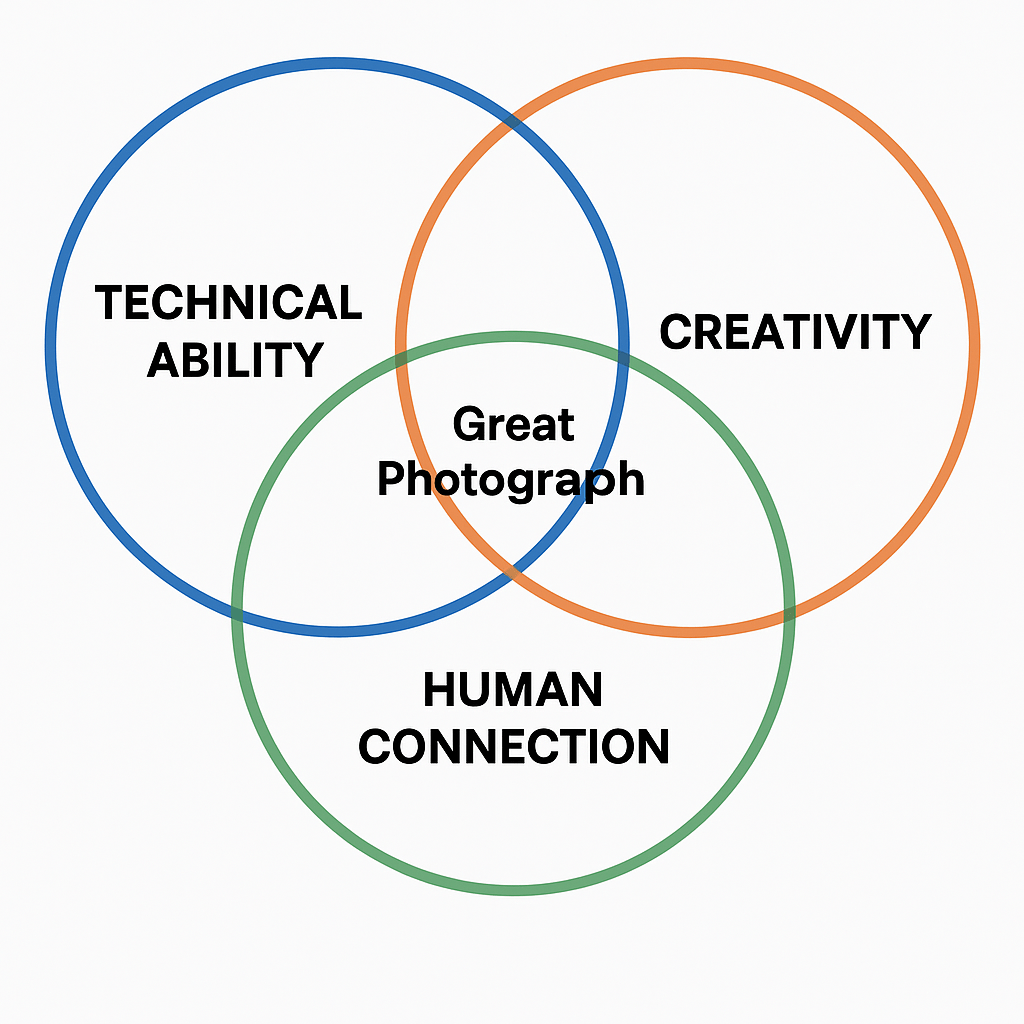
    1. Technical Ability

    The first circle is technical ability — the craft of photography. This includes mastery over the camera: control of lighting, exposure, focus, and all the technical elements that produce a good image. Composition also belongs here — the ability to use framing, scale, depth, and perspective to lead the viewer’s eye and communicate a sense of balance or drama.

    Technical ability ensures the photograph “works.” It’s the part of photography most often emphasized in competitions and camera clubs, where the precision of exposure or sharpness of focus is often rewarded. Many photographers take their inspiration from others and adopt well-known techniques, producing technically excellent but familiar images.

    There’s nothing wrong with that — but it’s only one circle.

    2. Creativity and Originality

    The second circle is creativity. Creativity goes beyond technique; it’s the spark of originality that brings something new into the world. It’s about experimentation, expression, and authenticity — the photographer’s ability to translate their own way of seeing into an image that feels fresh.

    Originality isn’t about novelty for its own sake, but about personal insight. A creative photograph makes us pause and think, “I haven’t seen it like that before.” It’s that sense of discovery that keeps photography alive and evolving.

    This circle can exist independently of technical mastery. Experimental and playful photography often thrives precisely because it breaks the rules. But when creativity and technical ability meet, something special happens — images that are both well-crafted and deeply original.

    3. Human Connection

    The third circle is the most vital and perhaps the most neglected: human connection. This is the power of a photograph to move us — to evoke emotion, empathy, or even challenge our beliefs.

    A great photograph doesn’t just show something; it makes us feel something. That emotional or intellectual spark connects photographer and viewer in a shared human moment. It might be joy, sadness, curiosity, or wonder — but it’s that connection that gives photography its lasting power.

    This is the circle where photography becomes more than craft — it becomes art.

    The Overlap: Where the Magic Happens

    Each of these circles can exist on its own. Technical photography might serve science or documentation — precise, accurate, and emotionally neutral. Creative photography might be exploratory or conceptual without technical polish. Photographs that focus purely on emotional connection might be spontaneous or imperfect, yet deeply moving.

    But in the overlap — where all three circles meet — we find the truly great photographs.

    These are images that are well-made, original, and emotionally resonant. They don’t just record the world; they reveal it anew.

    Artificial Intelligence and the Human Touch

    In the age of artificial intelligence, this third circle — human connection — becomes even more crucial. AI can now simulate technical ability and even mimic creative styles, but it struggles to convey genuine human emotion or imperfection.

    This should prompt us to ask: What makes a photograph truly human?

    Perhaps it’s the trace of the artist’s hand — the momentary decision, the emotional vulnerability, the imperfection that reveals authenticity.

    Rather than competing with AI for flawless production, photographers might lean into what makes us distinct: our ability to feel, to respond, to connect.

    In the future, photography that bears the mark of a real person — expressive, imperfect, emotional — may stand out as the most valuable of all.

    © Mark Waddington 2025

  • Why Authenticity and Originality Matter in Photography

    Why Authenticity and Originality Matter in Photography

    A photograph is never just about what’s in front of the lens. It’s also about the person behind it—their way of seeing, their choices, their experiences. When we look at a photograph, we’re not only seeing a subject, we’re also catching a glimpse of the photographer’s personality and intentions. That’s part of what gives an image its energy and life.

    It helps, then, to know something about the photographer. A bit of context—who they are, where they’ve been, what they’re trying to say—can deepen our connection to the picture. It can also help us decide how much we trust it as an expression of truth.

    Truth, of course, is especially important in documentary photography. But truth is not always easy to pin down. Even before artificial intelligence, photos could be staged, cropped, or stripped of context. Roger Fenton, one of the earliest war photographers, even carried a portable studio into the field. In one famous Crimean War image, cannonballs appear scattered across a road. Historians have long debated whether he placed them there himself—a reminder that questions about authenticity in photography are nothing new.

    The rise of misinformation has made these questions even more urgent. Images and stories circulate faster than ever, often manipulated or detached from their original context. Audiences now need stronger media literacy to separate fact from fabrication.

    This is why trust in named photographers and reputable news agencies matters so much. Our tradition of trusted journalism—such as the BBC—remains a vital safeguard. But the threat misinformation poses to democracy is real. Photographers and journalists carry the responsibility to represent events truthfully, and viewers share the responsibility of reading them critically. Truth in media is a collective task: without it, free speech risks losing its meaning. Agencies that cut corners with integrity won’t last long, because audiences must feel that the work they encounter comes from people who take truth seriously.

    Looking ahead, I suspect there will be a growing reluctance to over-process or over-dramatise photographs, precisely because of fears they could be mistaken for AI fabrications. When we look at a landscape, we’ll want the colours and atmosphere to feel believable. When we see a portrait, we’ll value signs of humanity—the imperfections, the individuality—over artificial polish.

    AI-generated images will always be built from patterns in existing material. That doesn’t mean they aren’t interesting, but it does mean the real challenge for artists will be to express something that feels truly original, rooted in lived experience.

    In this sense, AI may turn out to be a useful reminder. It could sharpen our awareness of what makes human expression so compelling. The best photographs will still be those that carry something no machine can invent: a lived emotion, a unique story, a way of seeing that could only have come from one person, in one moment, in one place.

    © Mark Waddington 2025