Tag: photography

  • Photographing in the Rain

    Photographing in the Rain

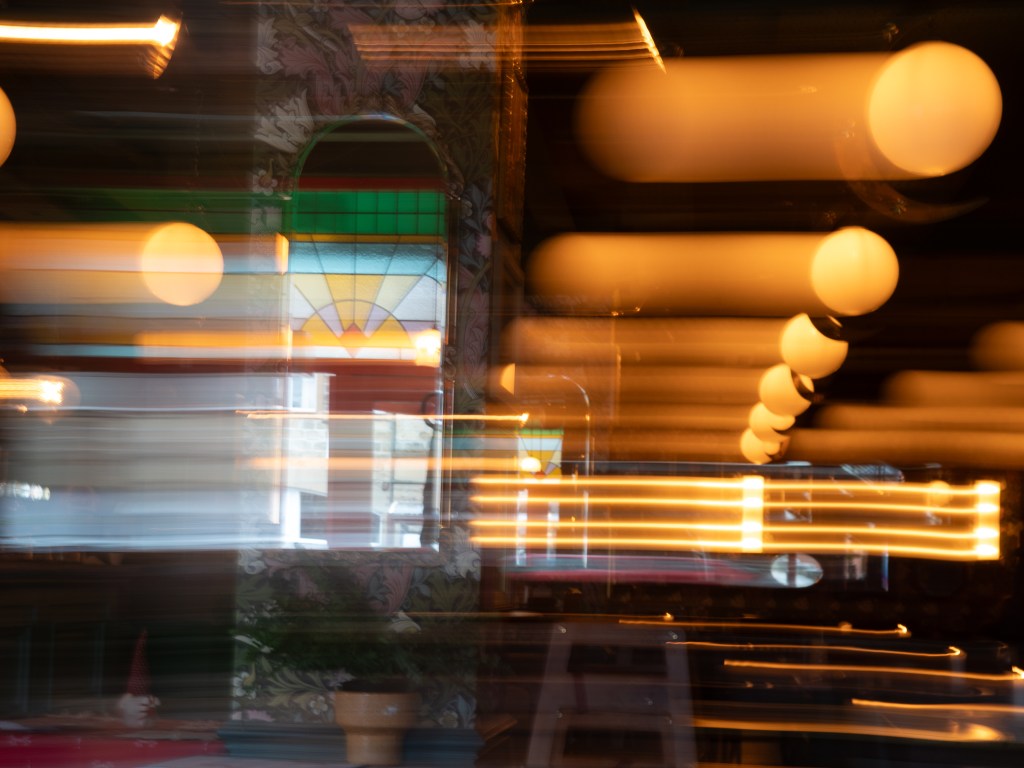
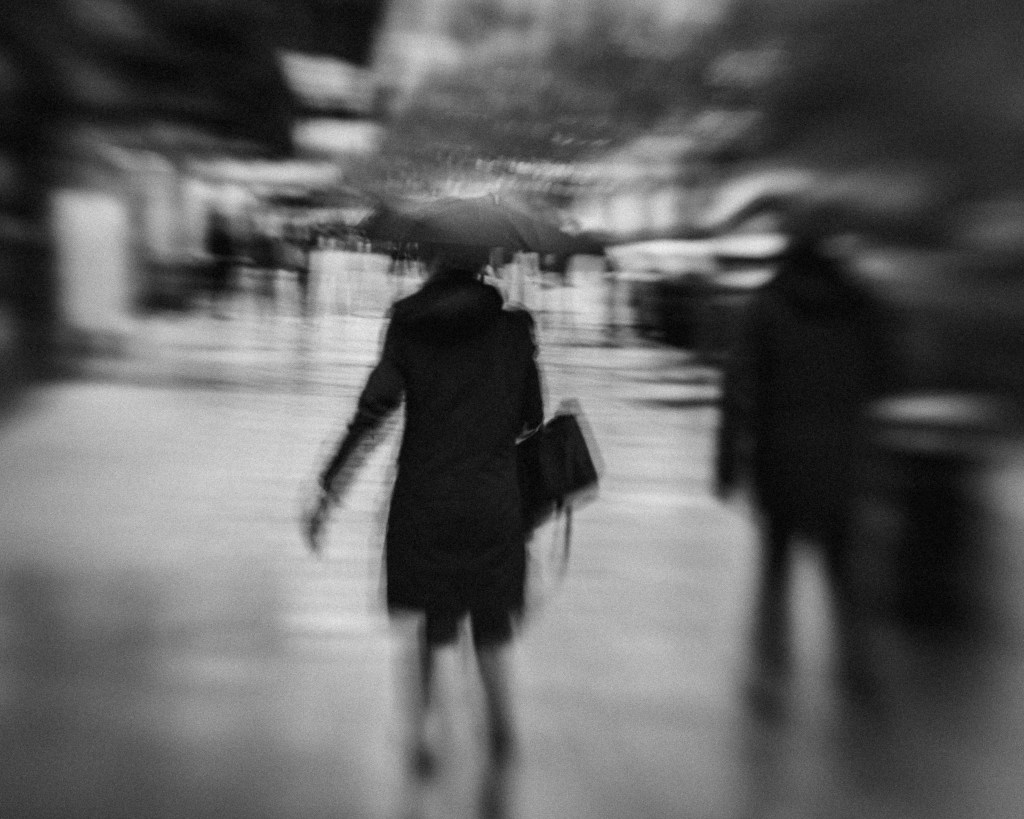
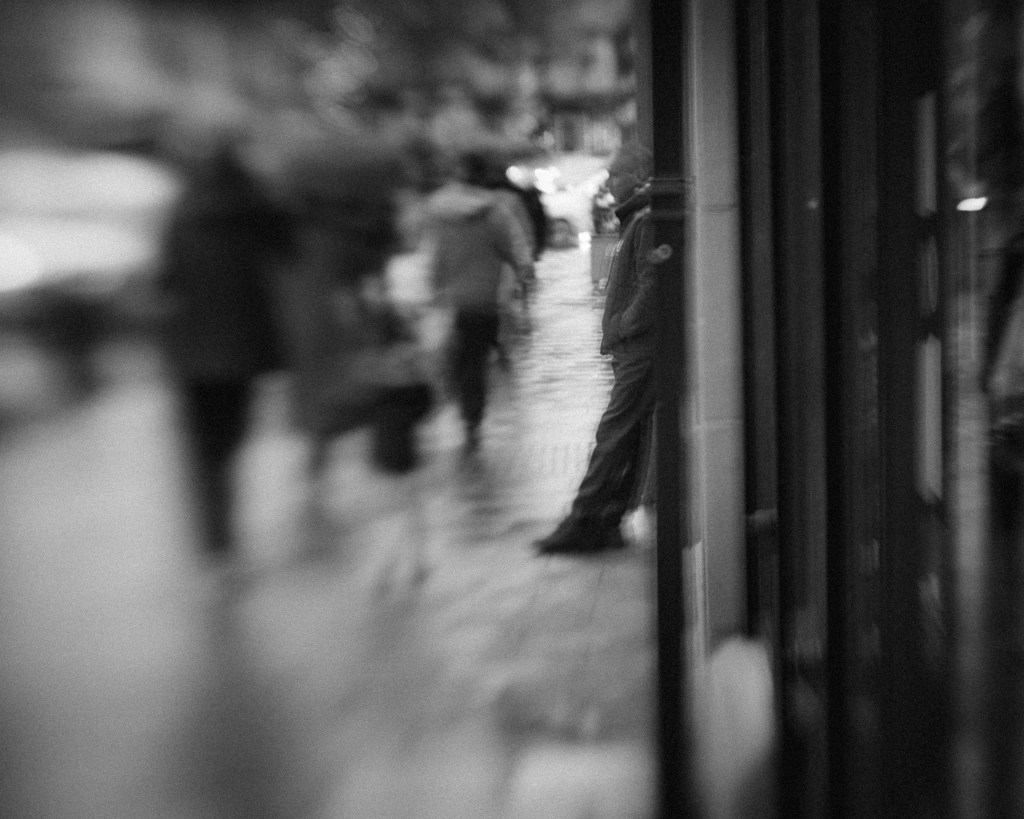
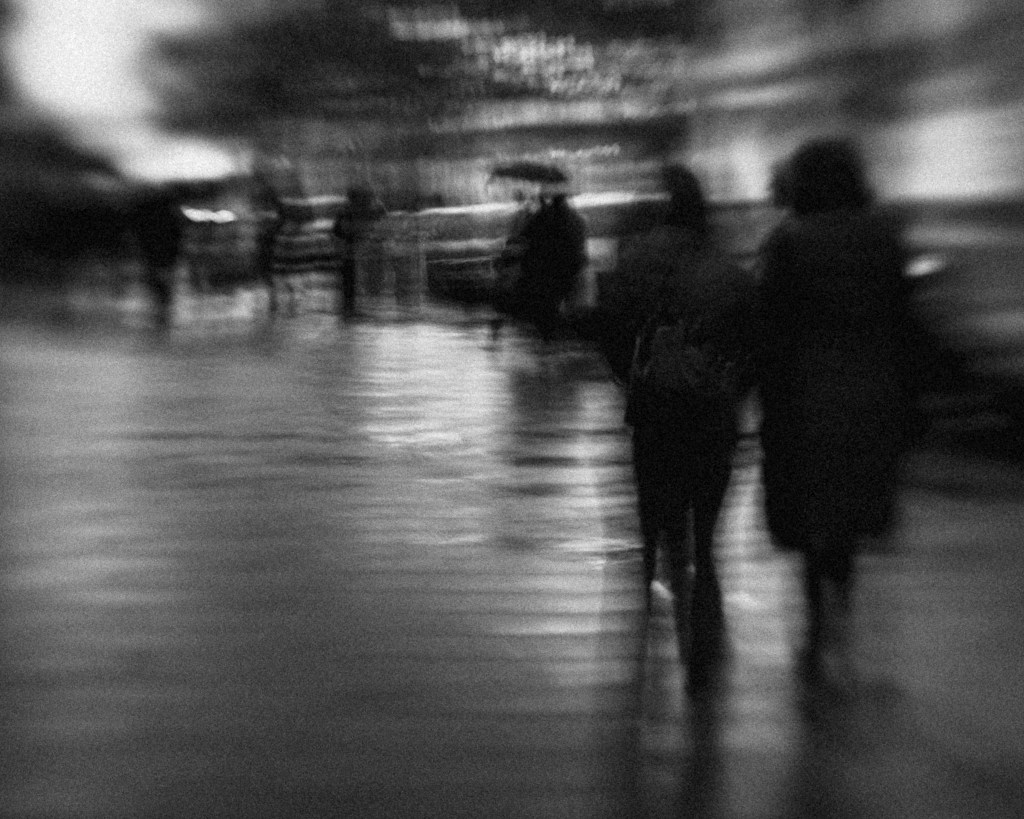
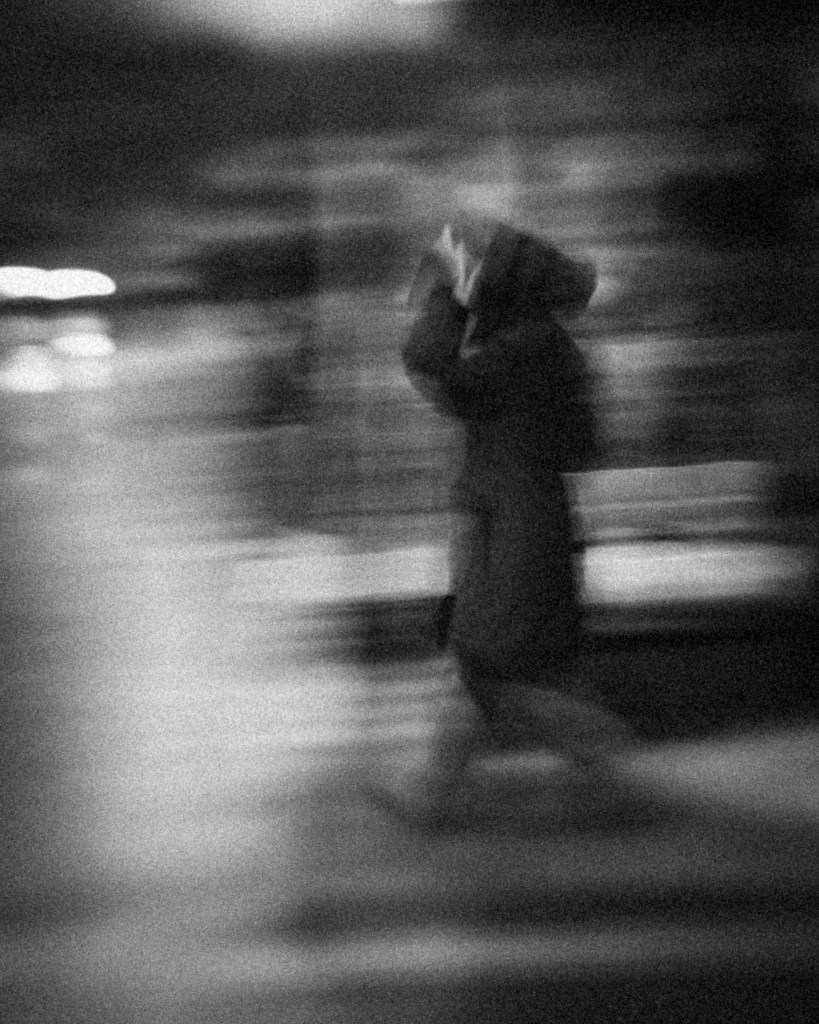
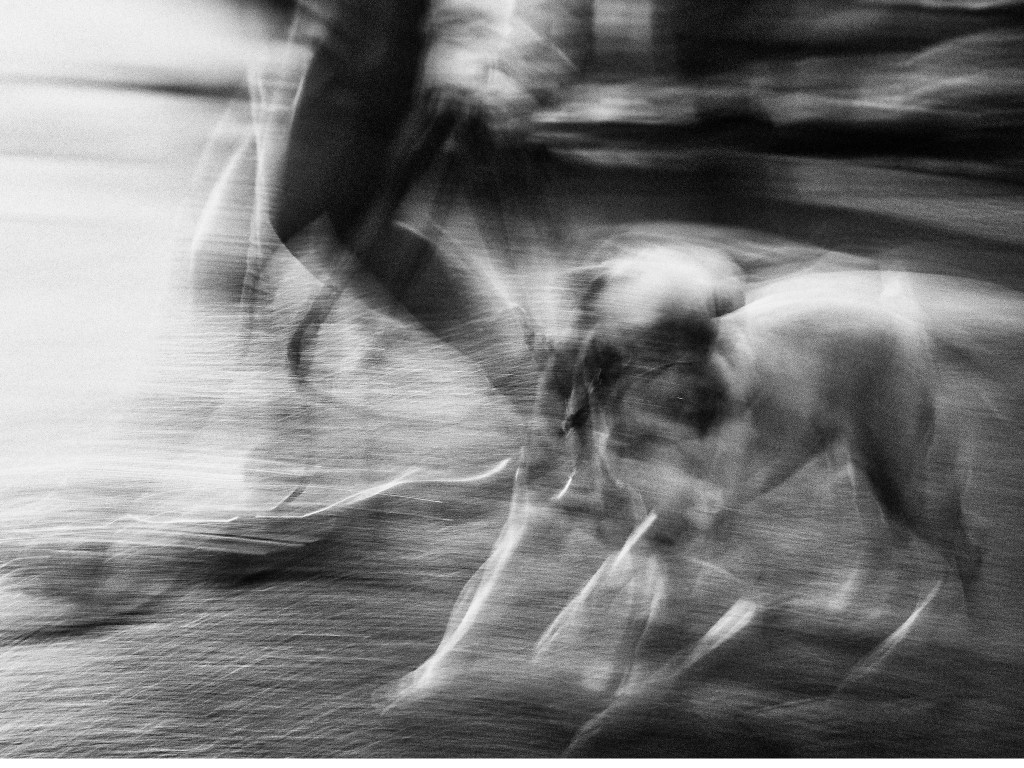
    I was out in the rain today, camera in hand, wandering through the town centre.

    Raincoats and umbrellas everywhere. People striding forward with purpose, determined to reach their destinations before becoming completely soaked. Commuters darting out of the railway station. Would-be shoppers sheltering in doorways. Pedestrians dodging the splash of passing cars. Children being hurried across the crossing, their little legs working overtime to keep up.

    It isn’t the sort of weather most people choose for photography.
    Surely a bright, sunny day would be better?

    And then there’s the expectation. Any self-respecting photographer might aim for images that are pin-sharp, colourful, and technically precise. Instead, my photographs today are black and white — dark, moody, slightly unfocused. Fleeting figures passing through the frame. Faces barely recognisable. Motion rather than clarity.

    So why do it?

    Because lately, I’ve been thinking less about what a photograph shows and more about what it feels like. I’m experimenting with techniques without expecting perfection. I’m allowing room to be surprised. I’m chasing a feeling rather than an explanation.

    Yesterday, I had a conversation about how we see. We’re very good at describing what’s in front of us — a street, a person, a rainy afternoon. But isn’t it far more interesting to describe what we feel when we encounter a scene?

    Perhaps our emotional response is a better measure of a powerful photograph than simple visual accuracy.


    The Four Stages of Seeing

    In my mind, the photographic process unfolds in four stages:

    1. Attraction – Something catches our initial attention.
    2. Framing – We compose the scene through the viewfinder.
    3. Selection – We choose which image deserves to be printed.
    4. Reflection – We stand back and look at the finished piece.

    At each of these stages, we often focus on what we’re seeing. But what if we paid equal attention to what we’re feeling?

    It’s almost as if, at our best, we momentarily forget the literal subject and respond instead to shapes, tones, contrast, movement — to atmosphere. To mood.


    A Challenge to See Differently

    My challenge to myself — and perhaps to you — is this:

    Switch off the rational, pre-programmed response that judges what makes a “good” photograph. Become more aware of how an image makes you feel.

    It may be unconventional. It may defy expectations. It may not win prizes for sharpness or colour.

    But if it strikes something deeper — if it lingers — then perhaps it has done something far more important.

    Sometimes, the rain gives us exactly what sunshine cannot.

  • A Studio Session at Ilkley Camera Club

    A Studio Session at Ilkley Camera Club

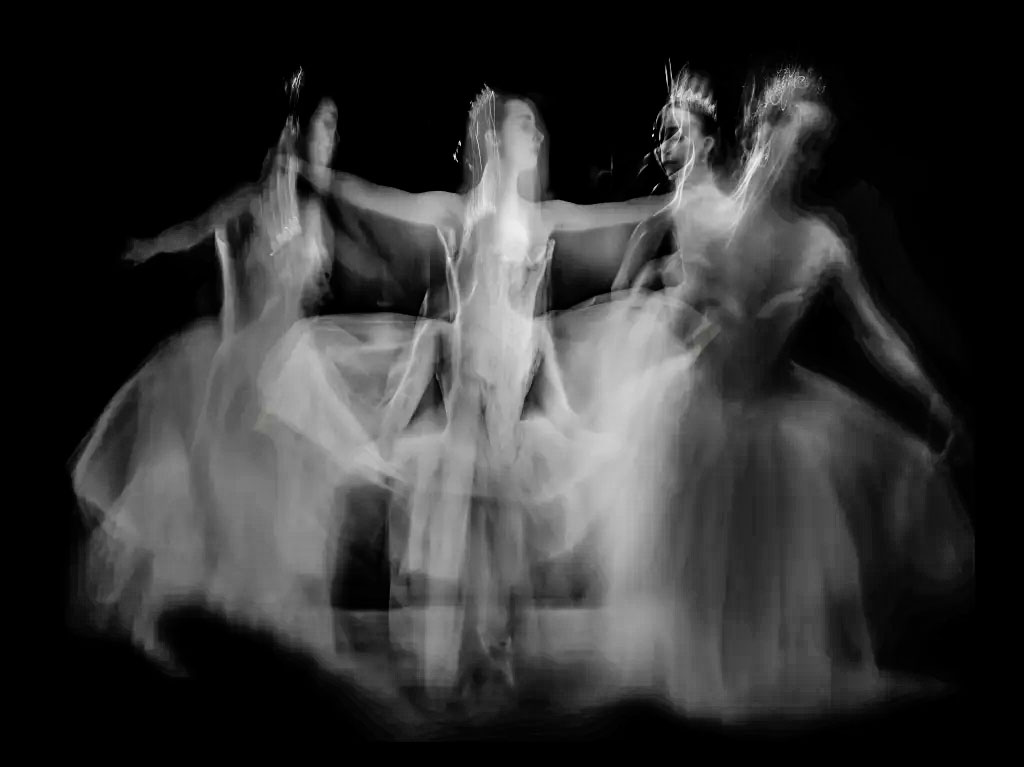
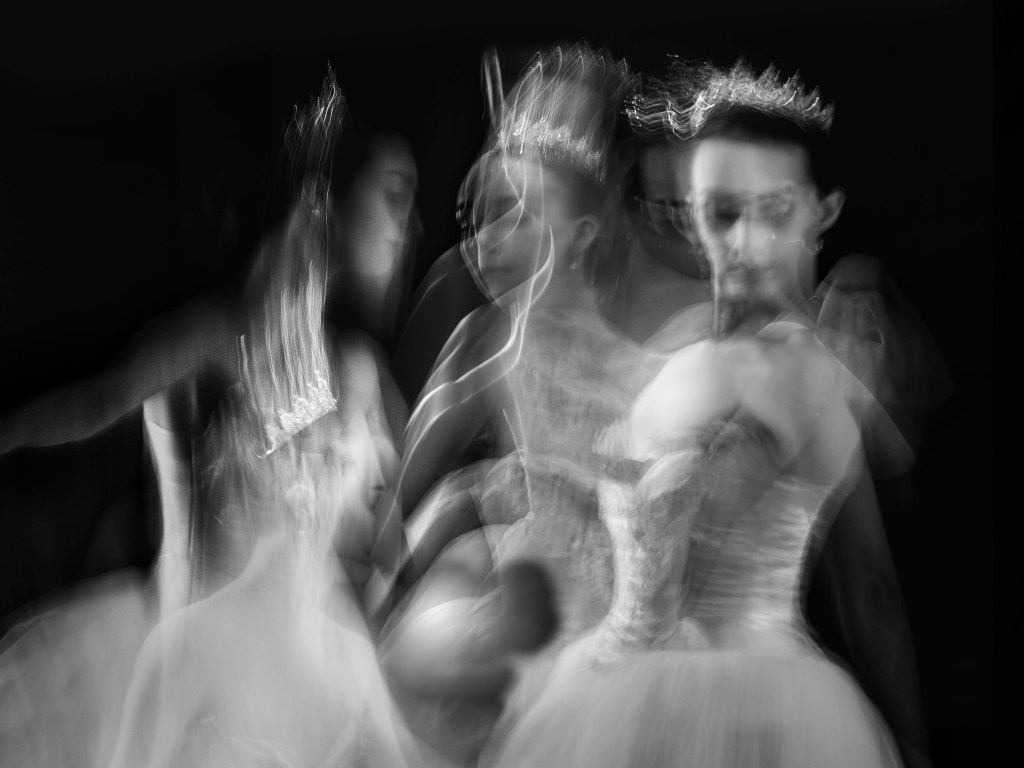
    Tonight at Ilkley Camera Club we had a fascinating practical studio session with Tabitha Boydell and model Erica Mulkern.

    Tabitha Boydell runs a business offering location shoots in some of the most lavish and visually striking settings around the country. Her events provide access not only to beautiful venues, but also to professional lighting setups, experienced models, and carefully curated costumes. (You can explore her work through her website.)

    This kind of session isn’t something I’ve done before. However, looking through Tabitha’s portfolio, many of the resulting images are truly spectacular.


    More Than Just “Taking the Shot”

    During the evening, Tabitha worked closely with Erica Mulkern to pose and create a studio lighting arrangement for us to use. Sessions like these are necessarily limited — especially when several photographers are sharing time and wanting to practise — but they offer an excellent opportunity to refine technical skills, particularly with strobe lighting, and to work with an experienced model.

    Yet beyond the technical learning, I was eager to explore something deeper.

    In a setting where the location, the lighting, and the model are already carefully prepared, the temptation is simply to “take the shot.” But a photograph is not merely a picture of something attractive. It is the outcome of a relationship — a “dialogue” between the photographer and the subject.


    Entering the Dialogue

    It is relatively easy to photograph something already beautiful: an elegant dancer, a dramatic landscape, a poised model. But what has the photographer contributed? What has been added beyond competent exposure and composition?

    The real challenge in creative photography is not simply to record beauty, but to respond to it — to enter into dialogue with it — and to allow that exchange to shape the final image.

    When photographer and subject truly interact, something new emerges. The subject offers presence, expression, character. The photographer brings interpretation, intention, and vision. The resulting photograph is not merely the sum of these parts, but something unique — a third thing born of that interaction.


    Bringing Ourselves Into the Frame

    In studio sessions like this, the question becomes: is it enough to capture what is placed before the camera, or should we bring something of ourselves into the frame?

    Looking at Tabitha’s portfolio, it is clear that many photographers who attend her sessions do more than document the scene. They add a layer of imagination — a personal response that transforms a well-arranged opportunity into something distinctly their own.

    Perhaps the true challenge, whenever we encounter a beautiful subject, is not simply to photograph it well, but to enter into a kind of conversation: to listen, to respond, and to shape something individual out of that relationship.

    In that sense, photography is less about taking and more about engaging — and the image becomes the visible trace of that conversation.

  • Story, History, and Playing with What’s Next

    Story, History, and Playing with What’s Next

    I had the pleasure of judging two print competitions at the Leeds Photographic Society last night. I loved the buzz of enthusiasm and friendliness. What also struck me wasn’t just the quality of the work, but the depth of the club’s history.

    Founded in 1852, it’s widely regarded as the oldest photographic society in the world — even older than the Royal Photographic Society. That’s quite something in a medium that has changed as dramatically as photography.

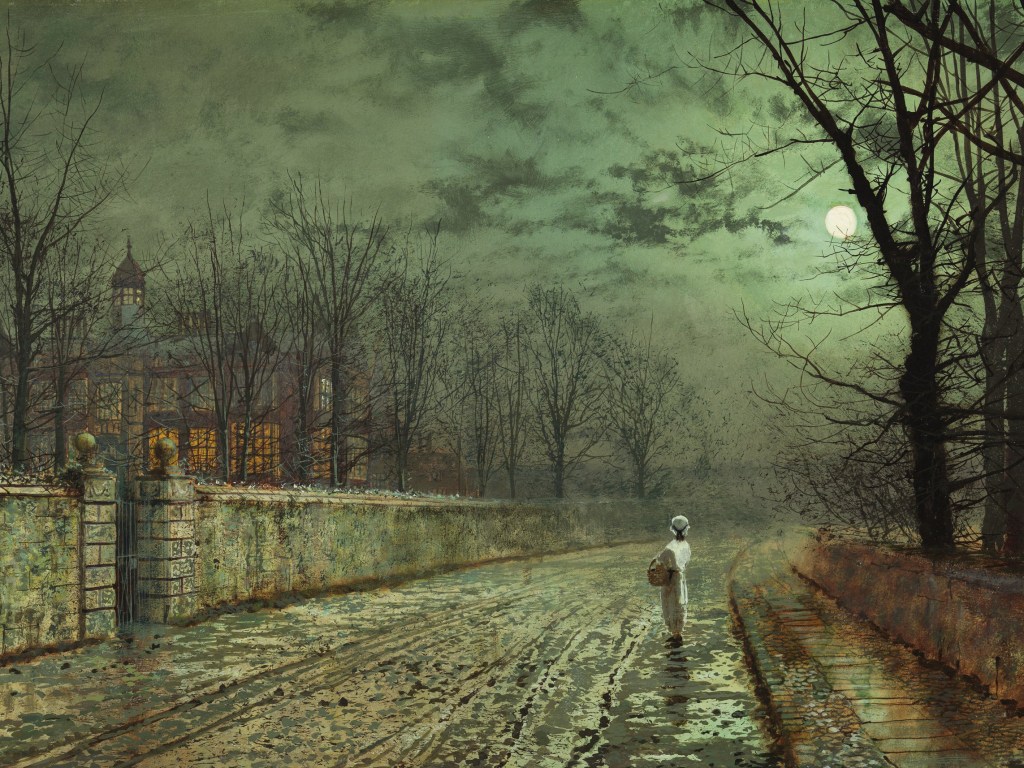
    I was introduced to some of that history recently at Leeds Art Gallery, seeing the work of John Atkinson Grimshaw, who joined the society in 1890. He worked at a time when painting and photography were in creative tension. Rather than resisting photography, he absorbed its influence — especially its handling of light — and let it shape his “moonlight” paintings.

    I’m not nostalgic for the past. There’s no point in trying to go backwards. But story matters. We all stand in the middle of one. The past shapes us, even as we move forward.

    At the competition, one self-portrait had been made using a flatbed scanner. The photographer placed her face on the glass and moved during the scan, creating strange, beautiful distortions. Others used sophisticated digital techniques in Photoshop. Different tools, same spirit: experiment and see what happens.

    It’s encouraging to see the Leeds Photographic Society — and many others — still thriving after so many years. But I sometimes feel that the approach to photographic competitions has remained a little static. Judging often still places heavy emphasis on technical perfection.

    Fifty or a hundred years ago, that made sense. Photography was technically demanding. Mastering exposure, focus, film choice, and the darkroom required real expertise. Technical competence was an achievement in itself.

    Today, technology is far more accessible. Good technical results are easier to achieve. Technical standards are now the starting point, not an end in themselves, as I’ve said before.

    Perhaps that’s the thread running from Grimshaw’s time to ours. The question isn’t how to preserve the past, but how to respond to what’s in front of us. If Grimshaw were alive today, I doubt he would ignore new technology. He would probably be playing with it.

    So how can these clubs and societies move forward while drawing on their past? How can they appeal to a new generation of photographers?

    I think the spirit of creativity is alive and thriving for those who are prepared to experiment — whether it’s sticking your face in a scanner, light painting with a torch at night, or taking photographs in the manner of J. M. W. Turner in the middle of a storm. Photography and creative expression should be exciting, and perhaps even dangerous.

    I hope the Leeds Photographic Society can keep the spirit of John Atkinson Grimshaw alive — not as a place of comfort and familiarity, but as a call to embrace the new and unfamiliar. To create something not seen before.

  • You Can’t Buy Photographic Excellence

    You Can’t Buy Photographic Excellence

    As I continue my journey in photography — particularly through critique sessions where we analyse images in detail — I’m finding myself increasingly weary of how much time we spend discussing technical aspects.

    There’s so much hype around camera equipment and its supposed ability to deliver technically perfect results. Sometimes I worry that we’re being hoodwinked into believing that “off-the-shelf excellence” can simply be purchased by upgrading to the latest gear.

    When I watch YouTube videos or scroll through Instagram, I’m inundated with adverts promising that this lens, that camera body, or some new accessory will elevate my photography. But the truth is, most of this equipment will not upgrade my photographic excellence — unless it comes with a brain transplant.

    A Refreshing Perspective

    That’s why it was so refreshing to attend a photo judging session with David Oxtaby the other night.

    While he acknowledged technical excellence, he made it clear that the real priority was emotional impact. That struck a chord with me. In the end, I sincerely believe it’s the emotional connection we feel with an image that truly matters.

    Technique Is the Starting Point, Not the Summit

    I want to be careful here. I’m not criticising the pursuit of technical excellence. In fact, I’ve written before that technical skill is essential — but it’s a starting point, not an endpoint.

    Once we’ve mastered the basics of exposure, focus, and composition, we’ve reached base camp. From there, we look up at the mountain. The real climb begins when we strive to express our stories, feelings, and identities through our photographs.

    Photographic excellence cannot be bought from Sony, Fujifilm, or Canon. It comes from passionate engagement with artistic expression — from the effort to create work that is emotionally engaging and culturally meaningful.

    Judging with the Heart as Well as the Head

    I’m currently judging another competition for a camera club in Leeds. Inspired by David’s session last week, I’m trying to be more deliberate in my approach — to slow down, meditate on each image, and pay attention to my emotional response.

    It may be that I’ll be criticised for not focusing heavily enough on technical aspects. My decisions may seem subjective. But if photographs are meant to strike deeper into the soul — if they are meant to move us — then technique alone is not enough.

    I do worry that I might confuse some people. But I’ll do my best to explain my reasoning. And perhaps there will be a few kindred spirits who align with my belief that truly powerful photography is not just seen — it is felt.

  • Reflections on Judging a Camera Club Competition

    Reflections on Judging a Camera Club Competition


    Last night I had the pleasure of judging at a local camera club, and I came away with several reflections I’d like to share.

    First, the club itself deserves real credit. It is friendly, welcoming, and clearly growing in membership. There is a wide range of ages and photographic interests represented, and it stands out as one of the most welcoming clubs I’ve judged at. It appears well organised, and the competition entries showed a broad spectrum of experience and ability. But drawing from my experiences over the last year of so …

    The Confidence Question

    One story I hear again and again when visiting clubs is that competitions tend to be dominated by a small core of regular winners. Those with less confidence often hesitate to enter at all.

    Confidence is a real issue. Competitions can, unintentionally, become divisive. They can create a perceived hierarchy — a sense that some members are “better” than others. This can become self-fulfilling: the confident members grow stronger and more assured, while the less confident gradually withdraw.

    That is not healthy for any creative community.

    The Double-Edged Nature of Competition

    I have genuinely enjoyed judging competitions over the last year or so. In fact, it has improved my own photography. Being required to articulate what makes a strong image forces clarity of thought. And when I cannot define precisely why an image works, I’ve learned to relax into that mystery rather than cling rigidly to rules.

    Competitions are, in many ways, a double-edged sword.

    On the positive side:

    • They encourage participation.
    • They stimulate engagement with club activities.
    • Judging can promote technical learning and progress.

    But we must also be aware that the very mechanisms that make competitions effective can, if unchecked, become corrosive.

    When Photography Becomes a Sport

    In some instances, club photography begins to resemble a sport. League tables, points systems, and rankings can feel uncomfortable. Elevating particular individuals to near-celebrity status may satisfy some egos, but it risks distorting the purpose of the club.

    Judging outcomes are inevitably limited. They are shaped by:

    • The subjective views of the judge.
    • A relatively narrow set of criteria designed to ensure fairness.

    Ironically, those criteria can sometimes reduce photography to a prescriptive formula — encouraging rule-following over artistic exploration.

    That said, I do not wish to be overly negative. For many members, the competitive element is exciting, stimulating, and rewarding. It adds energy and focus.

    But we must remain mindful of those who feel excluded by it.

    Risk-Takers and Rule-Followers

    Over the years, I have seen many innovative and creative photographers willing to experiment and take risks. They produce unusual, sometimes challenging work. If that work is dismissed because of technical “imperfections,” those individuals may feel discouraged.

    This creates two broad tendencies:

    • Those who conform to established rules and feel rewarded.
    • Those who experiment and feel undervalued.

    Of course, this is a generalisation. Reality is more nuanced. But the risk is real enough that we should be alert to it.

    Returning to Founding Values

    Camera clubs and photographic societies would benefit from revisiting their founding values.

    If a club genuinely aims to be open and to encourage photographic progress — not just personal achievement, but the development of photography itself — then it must embrace a wide range of approaches, styles, and philosophies.

    Photography has transformed radically since its inception, particularly in recent years with digital techniques and artificial intelligence. We cannot afford to judge as though we are still in the Victorian era.

    Creating Space for Creative Flourishing

    The priority, as I see it, is to create an environment in which creative people can flourish — and be rewarded for taking risks and breaking the mould.

    Photography should not stand still as an art form. Nor should our personal practice become stagnant. We want to feel the breeze of constant freshness moving through our work — an ongoing excitement about how photography can evolve and be deployed in new ways.

    A Thoughtful Way Forward

    In conclusion, camera clubs might consider:

    • Revisiting and updating their core values.
    • Reflecting carefully on how competitions are structured.
    • Designing categories and themes that are open enough to encourage surprise and originality.
    • Ensuring participation is as wide and inclusive as possible.

    Competitions can remain an important and vibrant part of club life — but only if they serve creativity rather than constrain it.

    If we get that balance right, camera clubs will not only nurture skilled photographers — they will nurture brave ones.

  • What Are You Really Trying to Say With Your Photographs?

    What Are You Really Trying to Say With Your Photographs?

    In my photography, I’ve always been drawn to the challenge of balancing two things: the strength of the content and the form of its presentation. I was brought up on the idea that content is king—but the longer I’ve worked with photographs, the more I’ve realised that we don’t always stop to ask what we actually mean by content.

    For me, content is not just what appears in the frame. It’s the message, the idea, or perhaps the story that the photograph is trying to express. Sometimes this is obvious and explicit; other times it’s subtle, implied, or left open. Strong content doesn’t shout—it steps forward quietly and invites the viewer to participate, to spend time unpacking what the image might be about.


    When Technique Takes Over


    When we’re out taking photographs, we’re not always conscious of content at all. It’s easy to be seduced by the visual appeal of a subject: the light, the colours, the textures, or how neatly it might fit into a well-composed frame. We’re often led to believe that a good photograph is one that is technically accomplished—sharp, well-exposed, carefully presented.

    Of course, technical skill matters. But there’s a risk here. When technical evaluation dominates, it can overshadow the quieter, more elusive qualities of meaning. A photograph can be visually impressive yet say very little. And without realising it, we can end up photographing how things look rather than what they might mean.

    Shifting the Emphasis Toward Content

    So how do we, as photographers, shift the emphasis away from surface appearance and towards content?

    One approach I’ve found helpful is surprisingly simple: learning to articulate, in words, what we have seen and what we are trying to achieve. Think about how exhibitions are often accompanied by an artist’s statement—an explanation of ideas, intentions, and approaches. Many of these statements are probably written after the work is finished. But I wonder whether there’s value in being able to speak about our intentions before or during the act of photographing. Not just for an audience—but for ourselves.

    Photography as a Question, Not an Answer

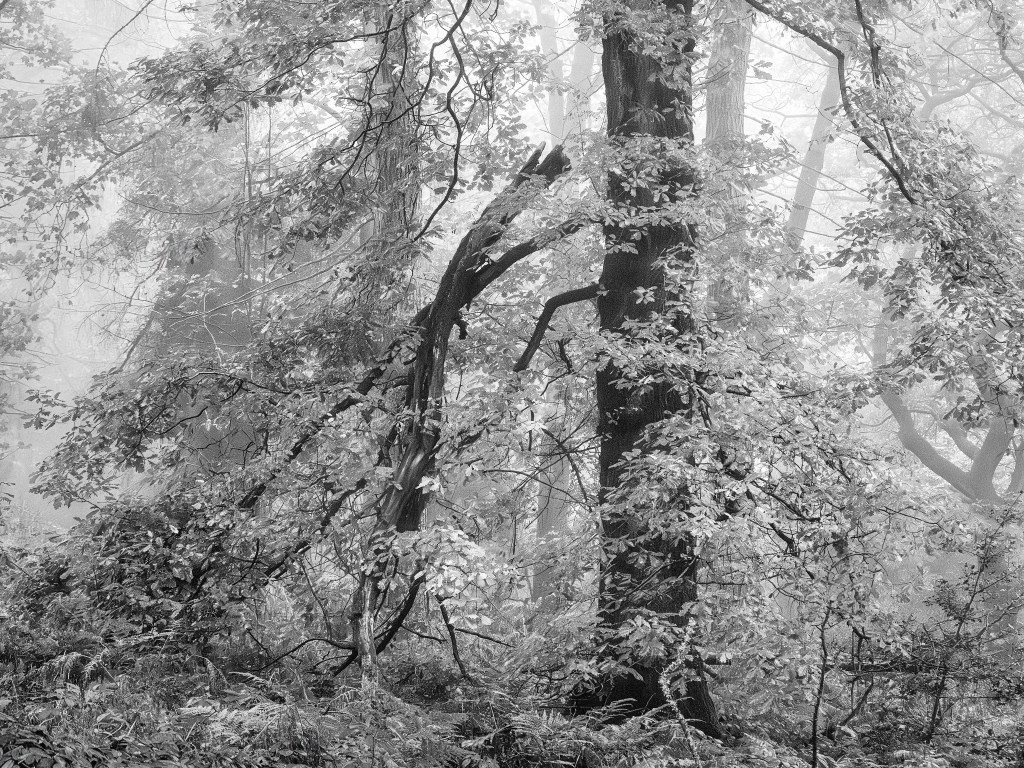
    Take something as ordinary as spending time photographing a local woodland. On the surface, the aim might seem obvious: to make beautiful images of trees, light, and landscape. But what do I really hope to come away with? What am I drawn to, again and again?

    For me, I’ve been trying to embrace the complexity of the woodland as a metaphor for the complexity of community life. I’m interested in how different elements coexist—how plants, animals, decay, growth, life, and death are all interwoven in cycles of dependency. Holding this idea in mind helps shape what I notice, where I linger, and what I choose to photograph. And hopefully, it carries something of that intention through to the final images and on to the viewer.

    Leaving Space for Mystery

    That said, there’s a balance to be struck. We don’t want our intentions to become so rigid that they close down the possibility of discovery. Photography thrives on accident, surprise, and moments we couldn’t have planned. Being too prescriptive can turn an open exploration into a narrow checklist.

    But a loose written or verbal statement—a starting point rather than a rulebook—can be incredibly useful. It can guide us toward work that feels more personal, more intentional, and perhaps even more distinctive. It gives us something to push against, return to, or gently abandon as the work evolve.

    Ultimately, learning to articulate what we’re trying to achieve isn’t about limiting our photography. It’s about giving it depth—and giving ourselves permission to look, think, and photograph with greater purpose.

  • Composition and Storytelling: And a Sense of Mystery

    Composition and Storytelling: And a Sense of Mystery

    In this post, I want to talk about two aspects of photography that I believe are absolutely essential: composition and storytelling.

    Composition

    Let’s start with composition.

    Composition is one of the few areas in photography where we have complete control. It’s where we can truly add something unique and personal — our way of seeing the world.

    But composition is more than simply arranging shapes and lines in a pleasing way. It’s also about how we use colour, tone, and light to guide the viewer’s eye through the image. I see colour and tone, along with lines and shapes, as all part and parcel of composition.

    I like to think of composition as design — the design of a photograph. How do all the visual elements fit together? How do they work as a whole? Good composition is about what some people might describe as harmony: the way shapes, lines, tones, and colours interact to create balance, rhythm, and flow.

    Storytelling

    Now to the second aspect: storytelling.

    When I talk about storytelling in photography, I don’t necessarily mean showing a literal story. It’s not always about a clear narrative within the frame. Often, it’s about creating a sense of story — hinting at something that feels as though there’s more happening beneath the surface. You can’t always explain it, but you sense it.

    That subtle uncertainty is powerful. It invites the viewer in. It makes them curious and encourages them to use their imagination.

    For me, that’s what makes an image memorable — when it leaves space for interpretation rather than spelling everything out. If a photograph is too literal or obvious, it can end up feeling a bit contrived.

    Beyond Rules and Definitions

    So composition and storytelling — those are the two areas I’m constantly thinking about and practising in my own photography (and failing at, most of the time).

    But there’s another layer to all this — something about how we talk about photography itself.

    When we try to explain concepts like composition or storytelling in words, we often end up simplifying something that’s deeply intuitive. Language helps us communicate ideas, but it can also trap us in definitions and formulas. Photography, at its core, is a visual language, not a verbal one. It’s something we need to feel rather than explain.

    The moment we try too hard to define what composition “should” be or how a story “should” be told, we risk losing the magic. Creativity doesn’t live in rules — it thrives in openness and curiosity.

    Maybe we need to loosen our grip a little. Instead of trying to control every element or chase a perfect formula, we can allow ourselves to respond emotionally to the scene in front of us. When we do that, photography becomes a kind of dialogue with the subconscious — a way of discovering parts of ourselves we didn’t know were there.

    So perhaps what I’m really saying is this:

    Let’s bring the mystery back into photography.
    Let’s make it less about certainty and more about emotion, intuition, and imagination.
    Let’s move away from rigid rules and embrace photography as something deeply human — something we feel our way through.

  • Layers of Interest in a Photograph

    Layers of Interest in a Photograph


    Picking up from my last post, I’ve been thinking more about what makes a photograph interesting — and in particular, about the idea of layers of interest. We can be drawn to an image for all sorts of reasons, but I want to focus on some of the more direct, obvious qualities that make a photograph work.

    The First Layer: The Subject Itself

    The most immediate layer of interest is the subject. Is it inherently interesting? Does it draw attention simply because of what it is — regardless of how it’s been photographed? This is when we think of a photograph as being of something. Some subjects have an innate visual or emotional pull — a dramatic sky, a face full of character, a fleeting gesture — and that alone can make a photograph compelling.

    The Second Layer: Design and Composition

    Another layer of interest comes from how the photograph is designed. How has the photographer composed the image? What has been included or left out? A well-composed image can feel balanced, satisfying, and beautifully arranged.

    I often think of this layer as using the scene in front of you as raw material for design. The interesting question, though, is how much that design reflects what was actually there — and how much it transforms it. Does the composition help me experience the scene more deeply, or does it pull me away from it? Does it reveal the reality of what I saw, or does it impose something artificial on top of it?

    The Third Layer: Meaning and Emotion

    Then there’s a deeper, more psychological layer — the one that deals with meaning. This is where metaphor, story, and emotion come into play. It’s what the photograph means rather than just what it shows.

    At this level, I’m interested in the relationships within the image — between people, objects, or ideas — and in the emotions they evoke. Sometimes this layer is very direct, like the expression on someone’s face. Other times, it’s subtle, hidden in atmosphere, symbolism, or mood.

    The Fourth Layer: Audience and Context

    Of course, even if a photograph has a fascinating subject, a strong design, and emotional depth, that doesn’t necessarily mean people will appreciate it. Whether a photograph is seen as “good” depends so much on the audience and the context in which it’s viewed.

    History is full of examples of art that was misunderstood or dismissed at first, only to be admired years later. The context of viewing — who’s looking, where, and when — can make all the difference. Finding an audience that connects with your work can be one of the hardest parts of being a photographer.

    A picture that leaves people cold isn’t necessarily a failure. It might simply be waiting for the right audience — or the right moment — to be understood.

    Communication and Value

    I sometimes think that one of the most interesting questions about art is not whether it’s good in any absolute sense, but whether it communicates. If we see all creative work as a form of communication — and not every artist does — then perhaps the real test of value is how effectively it reaches people.

    If a piece of art moves people, starts conversations, or even sells for millions, it’s clearly connecting on some level. In that sense, dismissing it as “rubbish” misses the point if its purpose is to communicate and be appreciated.

    So maybe the value of a photograph doesn’t just lie in its subject, design, or meaning. Maybe it also lies in the way it speaks to others — or even just in the fact that it speaks at all.

  • Seeing with the Imagination

    Seeing with the Imagination

    Hello — this is a quick post to capture a few thoughts before they get blown away by the winter winds.

    One of life’s great joys for me is visiting exhibitions, especially art exhibitions. I was thrilled recently to visit Cartwright Hall in Bradford to see the four shows from this year’s Turner Prize shortlist. Then, of course, there’s the annual Summer Exhibition at the Royal Academy — always a highlight — and closer to home, one of my favourite places is the Mercer Gallery in Harrogate.

    I mention all this because I believe art can be deeply inspiring for photographers — and not just the visual arts.

    Recently, I was listening to an interview with Philip Pullman, author of His Dark Materials. He said something that stayed with me: that it’s important to see with the imagination. There are things we can’t see with the naked eye — whole worlds that exist only when we engage our imagination. And those worlds, he said, are no less real.

    When you talk to artists, you quickly sense what moves and excites them — what drives them to create. Their work comes from the imagination, is expressed through imagination, and ultimately, it takes imagination to interpret it.

    Something I’ve noticed over time is that for many artists, the subject itself is often less important than the feeling the work creates — what it evokes in the viewer. They think in terms of colour, shape, line, and texture: the visual elements that carry emotion. Often, the subject is subtle, even withdrawn from the scene, inviting the viewer to work a little to uncover its meaning.

    Photographers, on the other hand, often take a different approach. We tend to focus on clarity — on the placement of the subject, the focal point, and where the viewer’s eye is being directed. Painters seem far less concerned with such precision. They work more through intuition and mystery, treating patterns, shapes, lines, colours, and textures as subjects in their own right. These elements are often what the work is really about — more so than simply depicting an object and placing it neatly within a frame.

    That’s not to say a clear subject isn’t important in photography, but perhaps the starting point could be the design — or even the feeling — rather than just the object itself. The subject might just as easily be light, atmosphere, or emotion.

    This is only a brief reflection, but it raises a question: do our familiar photographic formulas — with their emphasis on clarity and defined subjects — sometimes limit our imagination? Could the unseen elements in an image be just as important as the ones we include?

    As Philip Pullman suggested, can we “see through” a picture with the imagination? Perhaps what we leave out is every bit as significant as what we show.

  • The Three Circles of a Great Photograph 

    The Three Circles of a Great Photograph 

    This post is part of my ongoing exploration into what makes a great photograph. Lately, I’ve been asked to judge a few photographic competitions, which has really made me think about how we decide what makes one image stand out over another. To do that fairly, you need some kind of framework—a way to explain why certain photos deserve recognition. The tricky part is keeping those criteria simple enough to communicate, but broad enough to work across all the different styles and approaches you see in a competition. You have to think about things like technical ability, composition, and creativity—each of which is a deep subject on its own. And, of course, there’s always that tension between judging something “objectively” and knowing that, in the end, photography is a deeply subjective art.  

    When we think about what makes a great photograph, I believe we can draw three overlapping circles — each representing a vital dimension of photographic excellence. Together, they form a kind of Venn diagram for understanding not only how we take photographs, but how we create meaningful visual art.

    1. Technical Ability

    The first circle is technical ability — the craft of photography. This includes mastery over the camera: control of lighting, exposure, focus, and all the technical elements that produce a good image. Composition also belongs here — the ability to use framing, scale, depth, and perspective to lead the viewer’s eye and communicate a sense of balance or drama.

    Technical ability ensures the photograph “works.” It’s the part of photography most often emphasized in competitions and camera clubs, where the precision of exposure or sharpness of focus is often rewarded. Many photographers take their inspiration from others and adopt well-known techniques, producing technically excellent but familiar images.

    There’s nothing wrong with that — but it’s only one circle.

    2. Creativity and Originality

    The second circle is creativity. Creativity goes beyond technique; it’s the spark of originality that brings something new into the world. It’s about experimentation, expression, and authenticity — the photographer’s ability to translate their own way of seeing into an image that feels fresh.

    Originality isn’t about novelty for its own sake, but about personal insight. A creative photograph makes us pause and think, “I haven’t seen it like that before.” It’s that sense of discovery that keeps photography alive and evolving.

    This circle can exist independently of technical mastery. Experimental and playful photography often thrives precisely because it breaks the rules. But when creativity and technical ability meet, something special happens — images that are both well-crafted and deeply original.

    3. Human Connection

    The third circle is the most vital and perhaps the most neglected: human connection. This is the power of a photograph to move us — to evoke emotion, empathy, or even challenge our beliefs.

    A great photograph doesn’t just show something; it makes us feel something. That emotional or intellectual spark connects photographer and viewer in a shared human moment. It might be joy, sadness, curiosity, or wonder — but it’s that connection that gives photography its lasting power.

    This is the circle where photography becomes more than craft — it becomes art.

    The Overlap: Where the Magic Happens

    Each of these circles can exist on its own. Technical photography might serve science or documentation — precise, accurate, and emotionally neutral. Creative photography might be exploratory or conceptual without technical polish. Photographs that focus purely on emotional connection might be spontaneous or imperfect, yet deeply moving.

    But in the overlap — where all three circles meet — we find the truly great photographs.

    These are images that are well-made, original, and emotionally resonant. They don’t just record the world; they reveal it anew.

    Artificial Intelligence and the Human Touch

    In the age of artificial intelligence, this third circle — human connection — becomes even more crucial. AI can now simulate technical ability and even mimic creative styles, but it struggles to convey genuine human emotion or imperfection.

    This should prompt us to ask: What makes a photograph truly human?

    Perhaps it’s the trace of the artist’s hand — the momentary decision, the emotional vulnerability, the imperfection that reveals authenticity.

    Rather than competing with AI for flawless production, photographers might lean into what makes us distinct: our ability to feel, to respond, to connect.

    In the future, photography that bears the mark of a real person — expressive, imperfect, emotional — may stand out as the most valuable of all.

    © Mark Waddington 2025