Blog

  • Veil of Glass

    Veil of Glass

    I touch —

    gently —

    the traces of breath

    clinging to the veil of glass.

    Dreams leak slow,

    soft as smoke,

    caught in the trembling skin

    of their own mystery.

    The delicate suspension shivers,

    then falls —

    a blade of light

    splitting the wound.

    Beyond gray bone —

    sky, tree, shadow —

    a black nerve pulses, exposed.

    Ghosts scatter

    at the sharp edge

    of a careful, careful touch.

    I awake —

    and the mist parts,

    just enough

    to let the world through.

  • Beyond the Perfect Shot: Rediscovering the Heart of Photography

    Beyond the Perfect Shot: Rediscovering the Heart of Photography


    There’s a place we, as photographers, need to get to — a place beyond the world where a “good” photograph is defined solely by its technical excellence. Too often, photography is described in terms of composition, focus, exposure, and colour. Of course, these are all important. They are the foundation — the craft and mastery of the medium, much like learning to play an instrument or paint a picture.

    But once we’ve mastered the technique, we have to ask: what’s the music?

    The Music in a Photograph

    Photography, at its core, is about communication. It’s about making a connection between people and conveying something meaningful — something that transcends an accurate depiction of a scene. The real power of photography lies not in technical perfection, but in its ability to touch emotions, provoke thought, and speak to the times we live in.

    When I attend photographic competitions, I often notice that the emphasis remains heavily on the technical aspects — the sharpness, the exposure, the composition. Occasionally, a judge will mention originality or the message behind the image, but this is often secondary. And yet, it’s precisely that message — the intent, the emotion, the story — that gives photography its soul.

    Photography as Experimentation

    For me, the most exciting part of photography is its potential for experimentation — its ability to push boundaries and challenge what’s acceptable. Photography can be a playground for ideas, a space for those who like to break rules and explore the unexpected.

    When we treat photography as an experiment rather than a test, we open ourselves up to surprise, to discovery, and to innovation. It’s through risk-taking — through play — that photography evolves and remains vital.

    The Power of Collaboration

    Like many art forms, photography is not a solitary pursuit. At its best, it is a relationship — between the photographer and the subject, between the photographer and the audience, and often between creative collaborators.

    We can’t all be good at every aspect of the craft. Some excel in the technical, others in vision, storytelling, or presentation. That’s where collaboration becomes essential. Great creative work rarely comes from isolation; it emerges from relationships — from the energy, friction, and inspiration that collaboration brings. As a producer, I’ve seen that the most successful projects almost always come from collective effort and the shared drive to create something exceptional.

    What This Means for Camera Clubs

    So, what does all this mean for the average camera club?

    It means creating an environment where members can be brave — where they can experiment, take risks, and play with photography without fear of failure. Unlike commercial settings, amateur photography gives us the freedom to make mistakes and learn from them.

    Let’s encourage more experimentation, more unconventional approaches, and more creative risk-taking. Let’s move away from trying to imitate professional perfection and instead embrace photography as a living, expressive, and collaborative art form.

    Because in the end, photography isn’t just about capturing a perfect image — it’s about saying something that matters.

  • Seeing with the Imagination

    Seeing with the Imagination

    Hello — this is a quick post to capture a few thoughts before they get blown away by the winter winds.

    One of life’s great joys for me is visiting exhibitions, especially art exhibitions. I was thrilled recently to visit Cartwright Hall in Bradford to see the four shows from this year’s Turner Prize shortlist. Then, of course, there’s the annual Summer Exhibition at the Royal Academy — always a highlight — and closer to home, one of my favourite places is the Mercer Gallery in Harrogate.

    I mention all this because I believe art can be deeply inspiring for photographers — and not just the visual arts.

    Recently, I was listening to an interview with Philip Pullman, author of His Dark Materials. He said something that stayed with me: that it’s important to see with the imagination. There are things we can’t see with the naked eye — whole worlds that exist only when we engage our imagination. And those worlds, he said, are no less real.

    When you talk to artists, you quickly sense what moves and excites them — what drives them to create. Their work comes from the imagination, is expressed through imagination, and ultimately, it takes imagination to interpret it.

    Something I’ve noticed over time is that for many artists, the subject itself is often less important than the feeling the work creates — what it evokes in the viewer. They think in terms of colour, shape, line, and texture: the visual elements that carry emotion. Often, the subject is subtle, even withdrawn from the scene, inviting the viewer to work a little to uncover its meaning.

    Photographers, on the other hand, often take a different approach. We tend to focus on clarity — on the placement of the subject, the focal point, and where the viewer’s eye is being directed. Painters seem far less concerned with such precision. They work more through intuition and mystery, treating patterns, shapes, lines, colours, and textures as subjects in their own right. These elements are often what the work is really about — more so than simply depicting an object and placing it neatly within a frame.

    That’s not to say a clear subject isn’t important in photography, but perhaps the starting point could be the design — or even the feeling — rather than just the object itself. The subject might just as easily be light, atmosphere, or emotion.

    This is only a brief reflection, but it raises a question: do our familiar photographic formulas — with their emphasis on clarity and defined subjects — sometimes limit our imagination? Could the unseen elements in an image be just as important as the ones we include?

    As Philip Pullman suggested, can we “see through” a picture with the imagination? Perhaps what we leave out is every bit as significant as what we show.

  • Beneath the Leaves

    Beneath the Leaves

    My regular dog walks in Middleton Woods near home are always an inspiration. At this time of year, the leaves are turning, and the earth is full of fungi. It’s a time to reflect on the cycle of life and death — in fact, nothing truly dies; it simply moves on, transforms.

    In the last few days, I heard a wonderful talk by comedian Alan Davies at the Ilkley Literature Festival. When writing his autobiography, he said he realised it wasn’t about writing down what he knew, but about revealing what was unknown. That idea was, in a way, echoed by Iraqi exile Mohammed Sami, whose work I saw at the Turner Prize exhibition. He said, “The things I articulate in my artwork are memories hidden in the brain cells that are waiting for a trigger.”

    The idea of writing a biography is daunting, but in a way, all artwork is autobiographical. So, I am becoming more mindful of how these personal elements are reflected in our work.

    Recently, I followed an old stone path until I found myself slightly lost — and here’s a poem that grew out of that experience.

    Beneath the Leaves

    Boot soles press the forest spine,
    stone worn slick by hoof, paw, claw.
    Pilgrims pass—children, dogs,
    ancient traders long since gone 

    Sunlight pierces oak ribs high,
    warms the dark, wet earth to stir.
    A breath of mould, of sweetness, rises—
    death weaving its quiet magic here.
    The dying shines brighter than the living.

    Light seeps slow, a golden tide,
    ghosts of leaf and root stir beneath.
    Above, green dims… then flares,
    a singing of leaves,
    their final hue a requiem of hope.

    The congregation rises:
    roots, fungi, worms,
    whispers threading branch to branch.
    Balance hangs, held like a breath,
    waiting… before the storm ignites.

    And suddenly, the path is gone.
    I stand unmade,
    between the known and the unknown,
    between the hand and what reaches for it.

    This is the law:
    the tame unravels,
    the bright turns strange,
    the heart cracks open to its echo.
    The forest leans close, breathing.

    It will take me—
    bone, bark, and name—
    back into its ancient life.

    Beneath the leaves,
    beneath the leaves,
    the future waits,
    silent, patient, eternal.

    © Mark Waddington 2025

  • The Three Circles of a Great Photograph 

    The Three Circles of a Great Photograph 

    This post is part of my ongoing exploration into what makes a great photograph. Lately, I’ve been asked to judge a few photographic competitions, which has really made me think about how we decide what makes one image stand out over another. To do that fairly, you need some kind of framework—a way to explain why certain photos deserve recognition. The tricky part is keeping those criteria simple enough to communicate, but broad enough to work across all the different styles and approaches you see in a competition. You have to think about things like technical ability, composition, and creativity—each of which is a deep subject on its own. And, of course, there’s always that tension between judging something “objectively” and knowing that, in the end, photography is a deeply subjective art.  

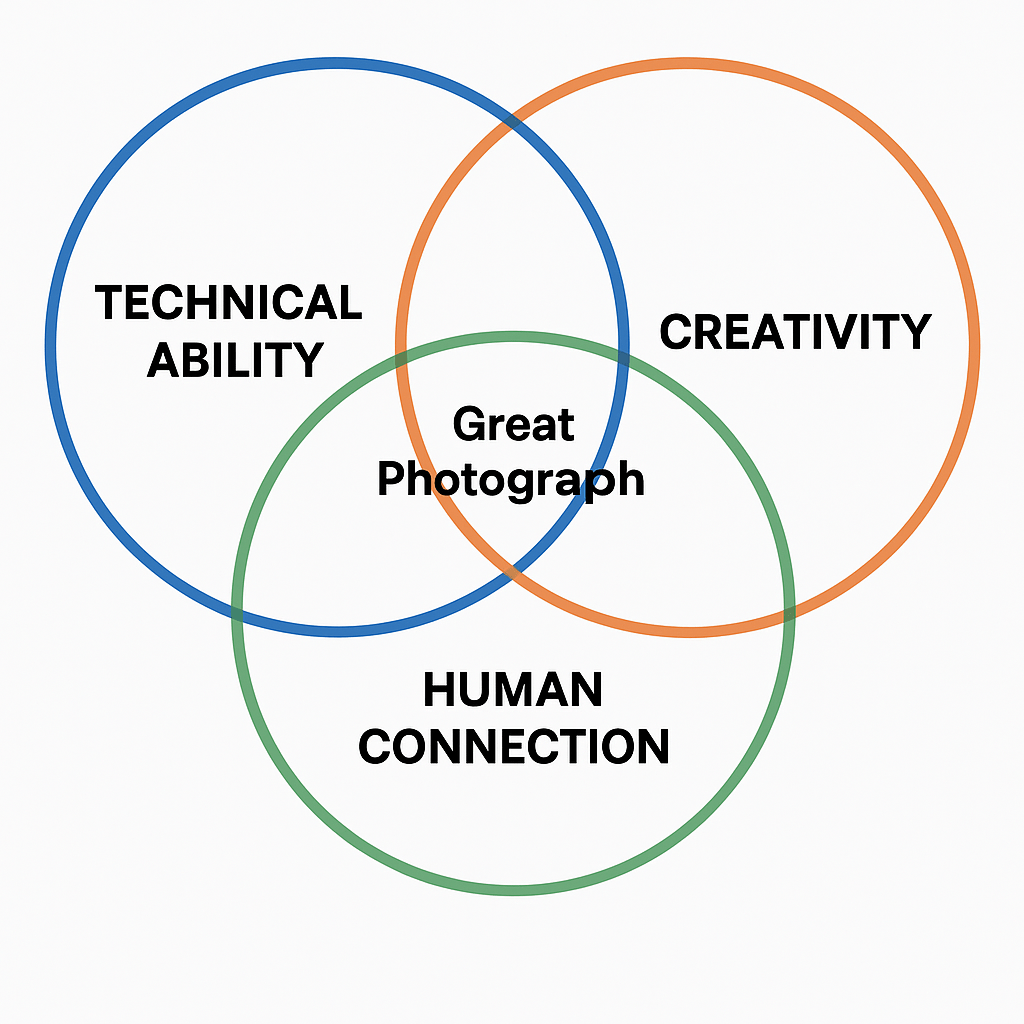
    When we think about what makes a great photograph, I believe we can draw three overlapping circles — each representing a vital dimension of photographic excellence. Together, they form a kind of Venn diagram for understanding not only how we take photographs, but how we create meaningful visual art.

    1. Technical Ability

    The first circle is technical ability — the craft of photography. This includes mastery over the camera: control of lighting, exposure, focus, and all the technical elements that produce a good image. Composition also belongs here — the ability to use framing, scale, depth, and perspective to lead the viewer’s eye and communicate a sense of balance or drama.

    Technical ability ensures the photograph “works.” It’s the part of photography most often emphasized in competitions and camera clubs, where the precision of exposure or sharpness of focus is often rewarded. Many photographers take their inspiration from others and adopt well-known techniques, producing technically excellent but familiar images.

    There’s nothing wrong with that — but it’s only one circle.

    2. Creativity and Originality

    The second circle is creativity. Creativity goes beyond technique; it’s the spark of originality that brings something new into the world. It’s about experimentation, expression, and authenticity — the photographer’s ability to translate their own way of seeing into an image that feels fresh.

    Originality isn’t about novelty for its own sake, but about personal insight. A creative photograph makes us pause and think, “I haven’t seen it like that before.” It’s that sense of discovery that keeps photography alive and evolving.

    This circle can exist independently of technical mastery. Experimental and playful photography often thrives precisely because it breaks the rules. But when creativity and technical ability meet, something special happens — images that are both well-crafted and deeply original.

    3. Human Connection

    The third circle is the most vital and perhaps the most neglected: human connection. This is the power of a photograph to move us — to evoke emotion, empathy, or even challenge our beliefs.

    A great photograph doesn’t just show something; it makes us feel something. That emotional or intellectual spark connects photographer and viewer in a shared human moment. It might be joy, sadness, curiosity, or wonder — but it’s that connection that gives photography its lasting power.

    This is the circle where photography becomes more than craft — it becomes art.

    The Overlap: Where the Magic Happens

    Each of these circles can exist on its own. Technical photography might serve science or documentation — precise, accurate, and emotionally neutral. Creative photography might be exploratory or conceptual without technical polish. Photographs that focus purely on emotional connection might be spontaneous or imperfect, yet deeply moving.

    But in the overlap — where all three circles meet — we find the truly great photographs.

    These are images that are well-made, original, and emotionally resonant. They don’t just record the world; they reveal it anew.

    Artificial Intelligence and the Human Touch

    In the age of artificial intelligence, this third circle — human connection — becomes even more crucial. AI can now simulate technical ability and even mimic creative styles, but it struggles to convey genuine human emotion or imperfection.

    This should prompt us to ask: What makes a photograph truly human?

    Perhaps it’s the trace of the artist’s hand — the momentary decision, the emotional vulnerability, the imperfection that reveals authenticity.

    Rather than competing with AI for flawless production, photographers might lean into what makes us distinct: our ability to feel, to respond, to connect.

    In the future, photography that bears the mark of a real person — expressive, imperfect, emotional — may stand out as the most valuable of all.

    © Mark Waddington 2025

  • Why Authenticity and Originality Matter in Photography

    Why Authenticity and Originality Matter in Photography

    A photograph is never just about what’s in front of the lens. It’s also about the person behind it—their way of seeing, their choices, their experiences. When we look at a photograph, we’re not only seeing a subject, we’re also catching a glimpse of the photographer’s personality and intentions. That’s part of what gives an image its energy and life.

    It helps, then, to know something about the photographer. A bit of context—who they are, where they’ve been, what they’re trying to say—can deepen our connection to the picture. It can also help us decide how much we trust it as an expression of truth.

    Truth, of course, is especially important in documentary photography. But truth is not always easy to pin down. Even before artificial intelligence, photos could be staged, cropped, or stripped of context. Roger Fenton, one of the earliest war photographers, even carried a portable studio into the field. In one famous Crimean War image, cannonballs appear scattered across a road. Historians have long debated whether he placed them there himself—a reminder that questions about authenticity in photography are nothing new.

    The rise of misinformation has made these questions even more urgent. Images and stories circulate faster than ever, often manipulated or detached from their original context. Audiences now need stronger media literacy to separate fact from fabrication.

    This is why trust in named photographers and reputable news agencies matters so much. Our tradition of trusted journalism—such as the BBC—remains a vital safeguard. But the threat misinformation poses to democracy is real. Photographers and journalists carry the responsibility to represent events truthfully, and viewers share the responsibility of reading them critically. Truth in media is a collective task: without it, free speech risks losing its meaning. Agencies that cut corners with integrity won’t last long, because audiences must feel that the work they encounter comes from people who take truth seriously.

    Looking ahead, I suspect there will be a growing reluctance to over-process or over-dramatise photographs, precisely because of fears they could be mistaken for AI fabrications. When we look at a landscape, we’ll want the colours and atmosphere to feel believable. When we see a portrait, we’ll value signs of humanity—the imperfections, the individuality—over artificial polish.

    AI-generated images will always be built from patterns in existing material. That doesn’t mean they aren’t interesting, but it does mean the real challenge for artists will be to express something that feels truly original, rooted in lived experience.

    In this sense, AI may turn out to be a useful reminder. It could sharpen our awareness of what makes human expression so compelling. The best photographs will still be those that carry something no machine can invent: a lived emotion, a unique story, a way of seeing that could only have come from one person, in one moment, in one place.

    © Mark Waddington 2025

  • Why Impact Matters in Photography

    Why Impact Matters in Photography

    I’ve been thinking a lot about one of the most important qualities a photograph needs if it’s going to be noticed and make its way in the world: impact.


    It’s the starting point for most photo competitions, and it’s often the first thing people respond to when scrolling online.

    But impact isn’t straightforward. I struggle with it, because the kind of work I really love often reveals itself slowly—the sort of photograph you hang on your wall and grow to appreciate more and more over time. That’s a slow burn, not a quick hit.


    The more I reflect, the more I realise that impact comes in different forms. It doesn’t always mean a punch in the gut or a visual assault. Sometimes it’s subtle, nuanced, and it unfolds gradually. The challenge is that we live in a culture where images flash by at lightning speed. Judges, social media users, and casual viewers all make split-second decisions.


    In competitions especially, clarity of intent matters. A photograph needs confidence—it should be clear what the subject is and where the viewer’s eye is meant to land. Try this exercise when scrolling through social media: ask yourself, What’s this photograph really about? Where am I being directed to look? You’ll be surprised how often the answer isn’t obvious. Without that sense of direction or intent, an image struggles to hold attention.


    And attention is scarce. It’s said we see up to 10,000 images a day across the internet, TV, magazines, and advertising. Who knows how accurate that number is, but it feels believable. Most of those images disappear without trace. Which raises the question: why do we even take photographs?


    Competitions give one answer. The judging process often starts with a quick scan: images might go into piles of “possibles,” “maybes,” and “rejects.” Only the possibles and maybes get a closer look. So yes, an image has to have presence—impact, appeal, engagement—whatever word you prefer.


    In advertising, I have heard the term “blink test” used: if someone hovers over an image for more than three seconds, it passes. Just three seconds to earn a second look. That’s why the internet pushes forward extreme content—violence, sex, or cute animals—because they stop the scroll. Think of recent “blink-worthy” photos: burning police cars, riots, or Donald Trump with his fist raised and bloodied face. These are images engineered to grab attention, and AI could well be used to  ensure they’re the ones we see most often. On platforms like X, truth matters less than clicks. That’s the blink factor at work.


    In this climate, impact becomes essential—not just for competition success but for survival in a saturated visual culture.

    So what do we actually mean by impact, and where does it come from?

    Looking at competition archives like those of the Photographic Alliance of Great Britain, certain patterns emerge. Impact might come from the drama of a sporting moment, the grandeur of architecture, a portrait that reveals character, or a landscape lit in a way that makes it sing. But here’s the real question: does the impact lie in the subject itself, or in how it’s photographed?


    You can, after all, take a perfectly ordinary photo of an impressive subject, or, perhaps, an impressive photograph of a very dull subject. But in competitions, judges usually want to see the hand of the photographer—the sense that someone has shaped the image, brought their own experience to it. Authorship matters. Otherwise, you end up in murky territory, like the famous “chimpanzee selfie,” where the camera’s owner claimed authorship of a photo the animal technically took.


    Different genres demand different skills. Photojournalists are judged primarily on access and storytelling, while landscape photographers might be evaluated on composition and presentation. But across genres, impact always comes down to the viewer. No viewer, no impact. And even when there is a viewer, their response depends on whether they’re open to what the photograph offers.


    That’s tricky in today’s oversaturated world, where familiar views quickly become clichés. How many photos have we seen of Dunstanburgh Castle or the Old Man of Storr? I love those places, but sometimes I don’t even bother taking my camera out because I’ve seen the same view too many times. The challenge is to make something familiar feel fresh—and that doesn’t come from gimmicks or heavy editing. It comes from lived experience.


    Impact is really about emotion being transferred from photographer to viewer. It’s the photographer saying, This is what I saw, and this is how I felt about it. If that excitement is genuine, it carries through. If it’s contrived—wrinkles on an elderly person exaggerated in black and white, or a dull sky made unusually dramatic with Lightroom sliders—it can feel wrong.


    That’s why original experience is so important. Many people today live secondhand, scrolling through social media and absorbing other people’s ideas whats hot and what’s not. If photography is to stand as a serious art form, it has to come from direct experience—what the photographer actually saw and felt. Passion is a good word for it. Does the image communicate passion for the subject?


    That passion can come through in unexpected ways. While iconic landmarks risk overexposure, everyday subjects can surprise us. Think of Vivian Maier’s New York street scenes or Edward Weston’s photographs of cabbage leaves—ordinary things made extraordinary through attention and care.

    Ultimately, photography is as much about presence as it is about timing—being there, being attentive, and being excited.

    Great portraits don’t just record faces; they capture relationships. Great landscapes don’t just show a place; they reveal how it felt to be there. The best photographs usually come with a story, they change what we think, feel and believe.

    © Mark Waddington 2025

  • Olga Karlovac

    Olga Karlovac

    If you haven’t come across Olga Karlovac, you may be inspired. Olga is a Croatian photographer known for her evocative black-and-white street photography.

    The images are captured at slow shutter speed to emphasise movement and blur, creating atmospheric and emotional compositions. The work I would say is semi-abstract often with a focus on human figures. She primarily works in black and white.

    I like that she defies the popular drive for ever sharper photos and careful, controlled composition. Olga, it seems to me, abandons herself to the environment she’s passing through and is not preoccupied with the technology of photography. She’s got a strong sense of her own style and emotional expression.

    Her website olga-karlovac-photography.com

  • Bradford

    Bradford

    These are images taken in Bradford last year. What I like about them is that they capture the character of the area and the sense of a story. I wish Bradford were not as grotty as it is in some places, but hopefully it will improve.