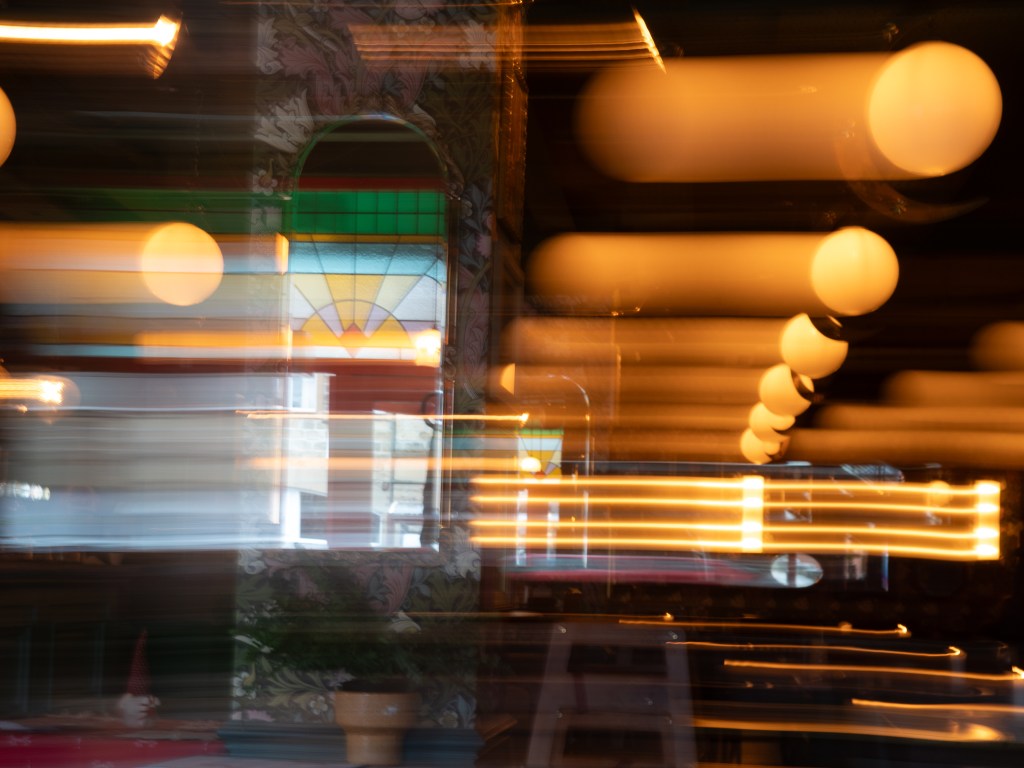
I’ve been agonising over a question that crops up regularly for me: when we create a piece of work, can we truly claim ownership of it, or are we simply attaching our name to something that happened almost by accident?
It’s really a question about intention. What part do we actually play in making photographs? This theme keeps surfacing in my convesations, perhaps because it touches on my own insecurity about creativity. I take the camera out, point it at something, press the shutter—and then, among dozens of failed images, I occasionally discover a good one. But does that make me creative? Does that make me a good photographer? Do I care?
In the late nineteenth century, Kodak famously promised: “You press the button, we do the rest.” It was a brilliant slogan. Photography would no longer be complicated or technical; anyone could do it. The machine would handle the hard part.
But when technology—or sheer luck—produces an image for us, what exactly are we claiming when we call it our work?
We like to talk about vision and intention. We prefer to believe that the image emerged from somewhere deep inside us, that it reveals our subconscious or our unique way of seeing. That language can sound grand, even pretentious. And yet it’s also true that photographs sometimes happen almost by accident: the light shifts, a stranger walks into the frame, the camera chooses the exposure. Still, we are happy to sign our name beneath the result, or take a competition prize.
I’m not suggesting that happy accidents are wrong, nor that allowing the camera to do the heavy lifting is somehow dishonest. In fact, one of the most important aspects of art may be recognition. We look at an image and think, Yes—that’s it. In that moment of recognition, the work becomes ours. We adopt it. We see ourselves in it.
It’s a little like the childhood expression: finders keepers. The accident becomes meaningful because we chose it. We found it. And in choosing it, we gave it significance.
Perhaps this says something about me. Maybe my photography grows partly out of insecurity. I want to show that I see differently, that I’ve been somewhere interesting, that I possess taste, depth, sensitivity. The camera becomes my way of saying: Look at me. Look where I am. Love me!
There’s undeniably an element of self-promotion in that.
And there’s nothing inherently wrong with wanting to feel distinct or valued. But if photography is to mean something more—if it is to anchor us in reality rather than merely decorate our ego—then we must examine our motives. Are we revealing something true, or are we simply curating a version of ourselves?
Letting the camera “do the rest” is not enough. The real work begins afterwards. It begins when we ask: Why did I take this photograph? What drew me to that moment? What was I feeling? What am I trying to say?
Photography can become a conversation with ourselves. We take pictures, we review them, we respond, and we change. It becomes iterative—not about producing perfect images, but about developing deeper awareness. Over time, we begin to recognise our preferences, our longings, even our blind spots.
Creative expression is messy and uncertain. It doesn’t always arise from grand inspiration; sometimes it begins with accident, curiosity, or even vanity. But if we stay attentive, photography can move beyond technology and self-presentation. It can become a slow, ongoing attempt to understand both the world in front of us and the person holding the camera.
And that final part—the self-understanding—is something no camera can do for us.


 Mark Waddington
Leave a comment